
In a world where content is dominated by short videos and AI snippets, it’s easy to think that long-form content is slowly becoming obsolete. With younger audiences having reduced attention spans and social media taking the forefront for many users, do people still want deep dive content?
The reality is, yes, long-form content is still relevant, but in the changing digital landscape, it’s evolved to suit modern user demands.
In this blog, we’ll dive into long-form content and how brands can adapt their strategy to ensure success.
For content that’s built to perform, our content marketing experts at Embryo can create bespoke SEO blogs, guides and more that put your brand on the map.
What is long-form content?
If you’re new to the marketing game, you might be unfamiliar with the different types of content. In simple terms, long-form content is comprehensive or detailed media designed to educate audiences, answer key questions and develop authority for a website.
Usually 1000 words or longer, there are many different types of long-form content from blogs and guides to white papers, case studies and social media posts.
Long-form content also includes non-written media like podcasts, video guides, and webinars that explain key topics without the need for reading.

Where long-form content excels
Long-form content isn’t the answer in every situation, and it works best as part of a specific wider strategy. Some of the places where this content shines include:
- Video tutorials, guides, and step-by-step blogs
- Niche topics with competitive keywords
- High intent searches where users want to research topics before converting
- Thought leadership pieces that convince users of expertise and authority
Why long-form content still matters
Targets complex and long tail queries
Search behaviours are not as straightforward as people may think, and a mixture of short and long tail queries is still prominent on search engines.
Many user queries can’t be answered with short-form content, with keyword searches like “how to” and “best x” comparison queries being best suited to detailed, longer-length content.
Search engines display content that best matches user intent, and long-form content performs well for these searches because it addresses a range of topics, answers frequently asked or related questions, and offers essential context like examples, demonstrations, and frameworks.
All these points are what Google and other search engines use to determine if content is relevant and valuable, and long-form media that addresses these points well will inevitably perform in the SERPs.
Deep diving into topics helps rankings
Longer content doesn’t mean better quality, and the value of long-form content comes from the depth and expert exploration into a specific topic.
Striking the balance between length and quality is what gets your content seen in the SERPS, and the stats support this. The average length of content on the first page of Google is between 1,400 and 1,900 words, indicating that, in general, long-form content is highly valued by search engines.
But why is this the case? Well, with more words to play with, you have more opportunities to include natural keyword variations, more internal links, and more E-E-A-T signals.
Builds authority for your brand
Short-form content is great for getting your company seen and showcasing your products/ services, but long-form content is what builds authority.
With the increase in AI content across all platforms, E-E-A-T signals are more important than ever in 2026 (codeguys), with proven experts and trusted sources taking the forefront in the SERPs. Content that showcases expertise with statistics, case studies, or original research helps your brand build authority, especially in niche markets and complex industries like STEM, healthcare, and B2B trade.
Long-form media increases ROI in the long term
One of the biggest reasons to invest in long-form content is the potential for long-term return on investment. Blogs, videos and guides, especially those that feature evergreen content that has continuous value, have the potential to rank for a range of keywords and also generate 77% more backlinks than shorter media (Search Engine Land).
The long-term relevance of this content also allows for consistent organic traffic, helping to maintain authority.
It helps inform users’ decisions
Research is a huge part of the user journey, and before making a decision on the right product or process, users want to explore the topic in depth.
Comparison blogs that discuss multiple options, whitepapers exploring a specific product and video reviews are all vital parts of the decision-making process. For many users, especially B2B businesses, exploring gated content like whitepapers is the first step that leads to conversion.
Positioning yourself as a thought leader in your industry with detailed, dedicated long-form content helps users trust your opinion and expertise, leading to higher conversion rates than short-form materials (Sunoco).
The changing role of long-form content
It’s clear that long-form content is here to stay, but just like everything else online, it’s been forced to change to suit user demands.
With AI slop all over our TikTok and Instagram feeds, and AI overviews and snippets offering condensed information above the fold, content as a whole and its purpose have evolved.
Short-form content is designed to feed top-of-the-funnel traffic and initial engagement, whereas long-form content aims to convert users, build trust, and answer key user questions.
It’s important to remember that any successful strategy shouldn’t rely solely on one form of content. For the most reach and conversions, a mix of long-form and short-form content should always be used to target every type of user.

Word count is taking a backseat
Traditional SEO strategies relied heavily on the idea that more is better. 2000-word-plus articles were often common practice, but as search engines have evolved, it’s become even more important to focus on quality over quantity.
Google and other search engines can now identify AI-generated and filler content as well as poor writing, much more easily in 2026. This means that a 3,000-word article with repetition, bad writing, or AI-generated text will always rank lower than shorter, high-quality pieces.
There’s no longer a “minimum word count” for long-form content, meaning you can create an 800-word blog full of E-E-A-T-rich copy that demonstrates more value and beats longer copy in the SERPs.
The role of AI in content creation
AI is a brilliant tool that can help support the writing process and generate fresh ideas, analyse competitors and suggest structures, but it should never be used as a writing solution.
Although it might be tempting to use AI to write guides, blogs or generate video content, it lacks the human input that makes content original and perform well in the SERPs.
Long-form content performs best when it includes original insights, first-hand or expert experience, and relates to the consumer, something that AI content often fails to achieve.
If you’re creating long-form content as part of your marketing strategy, it’s important to remember that search engines reward content that demonstrates real experience and expertise, not just great writing.
How to repurpose longer content
Content strategies in 2026 have adapted to become smart about how content is used, and the best strategies utilise long-form content and repurpose it into fresh media to use across multiple channels. This is known as content syndication.
For example, a 2,500-word guide covering the best products in your collection can be transformed into a number of new pieces, including:
- Several short-form videos discussing each product.
- Social media posts with snippets from the blog accompanied by imagery and user reviews.
- Reworded key information for FAQ landing pages or product descriptions.
With this approach, you can capture multiple audiences across a number of platforms, reinforce authority, and maximise ROI from a single piece of content.

Key Takeaways – Long-form content is still as important as ever
The main thing to take away from this discussion is that long-form content isn’t going anywhere; it’s just developed. Content that focuses on length over substance no longer performs, and in a competitive digital landscape, the focus has to be on quality content and establishing authority.
If you’re ready to adapt your content strategy to meet new search engine and user demands, your long-form content can become more valuable than ever.
Make long-form content work for you with Embryo
High-performance content isn’t just about good writing; it requires smart SEO expertise and a strategic understanding of search intent and keywords.
That’s where Embryo comes in. Our content creation experts specialise in crafting quality, data-driven media in all forms. Whether you’re looking to build brand awareness or increase organic traffic, our content team will work with you to create long and short-form content that drives measurable growth.
Get in touch today and discover how we can transform your marketing.
We all love a Maccies… however, McDonald’s is not just dominating the fast food industry with its tasty bargains, but also with its marketing prowess!
In this blog, I’m here to take you on a deep dive into history throughout McDonald’s marketing campaigns, highlighting key moments that you may or may not remember and discover what makes their marketing so lovable and memorable. As a leading digital marketing agency, here at Embryo, we know a thing or two about what goes into a great marketing campaign.
Their ice cream machine might always be down, but their digital strategy is always up and running. Get ready to travel back in time…
Early 2000s – 2010
The world of digital marketing didn’t really exist until the noughties, acting as a sidecar to TV. However, this early era is what really laid the groundwork for McDonald’s TOV and brand voice. Their iconic slogan ‘I’m lovin’ it’ wasn’t just a TV advert, but their first global multi-channel campaign. It featured a digital rollout and collaboration with Justin Timberlake, in which he sang the iconic ‘ba da ba ba ba’ hook for McDonald’s.
This was essentially McDonald’s first-ever global digital marketing campaign, and signalled their intent to capture a younger, tech-savvy and hip audience. The song was even released as an EP in late 2003!
McDonald’s Monopoly also became prevalent during this time period. The ‘Monopoly Best Chance Game’ used physical, peel-off game stickers on its packaging to collect property sets or win instant prizes. However, Monopoly soon shifted to the digital world, forcing customers to engage with their website to check wins, creating their first massive digital database of users.
2011-2015: The era of listening
The introduction of social media truly changed the game for most brands. Instead of just pushing ads, McDonald’s could now use digital platforms to rebuild trust after documentaries like ‘Super Size Me’ damaged its reputation.
In 2012, McDonald’s launched ‘Our Food. Your Questions.’ in Canada, a revolutionary digital transparency campaign. They made a dedicated website and YouTube channel to answer gross customer questions such as ‘Is your meat real?’ in a bid to turn distrust into a competitive advantage. They invited customers to ask anything, and they actually answered.

It wasn’t just a TV ad… It was an interactive digital platform, shifting McDonald’s from preaching at customers to actively listening to them. The campaign relied solely on what the audience wanted to know about, ensuring that the content was relevant and highly shareable across all social media channels like Facebook and Twitter.
2016 – 2020: An app-first strategy
Moving from marketing on digital platforms to becoming its own digital platform, the McDonald’s loyalty app was launched. While it officially launched in 2015, it wasn’t until 2016/2017 that users could order directly from the app, and this is what turned Maccie’s into a true e-commerce player.
Before their app, McDonald’s was data blind; however, thanks to their new loyalty programmes via their app, they were offering small deals in exchange for a lifetime map of their customers’ eating habits, allowing them to create predictive models of when customers were most likely to get hungry.
In 2019, McDonald’s acquired an AI company to create smart drive-thru menus that changed in real time based on the weather, time of day, and restaurant traffic. This was also the time period that McDonald’s rolled out self-service kiosks globally, using clever techniques like upselling algorithms to increase check sizes by 10-15%!
2021 – present: The modern era
That takes us up to Covid-19 & beyond. Currently, McDonald’s is taking over the digital marketing world by leaning into the weird and wonderful ways that fans are eating their food and introducing celebrity and influencer endorsements.
They’ve worked with celebrities like Stormzy, encouraging customers to ‘Order Like Stormzy’ and try his favourite Maccies combo. This is a clever marketing technique that makes customers feel closer to their favourite celebrities, because no matter how big and famous you are, everyone has a favourite McDonald’s order.
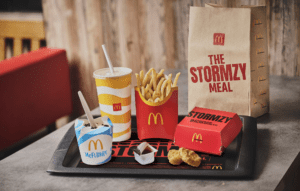
Beyond this, McDonald’s has come a long way from just selling cheap junk food to a data-rich, reliable brand that lives in the pocket of millions of consumers around the world. MyMcDonald’s rewards collaborated with current UK influencers while also letting customers donate their points to British charities like BBC Children in Need, RMHC, and more.
One of their most recent campaigns shows just how much Maccies is integrated into our daily lives. They use unedited photos from customers’ phones showing the authentic, messy end to a night out with McDonald’s as the last stop. They also launched more of a cultural context at the 2026 Brit Awards, reinforcing the idea that McDonald’s is the ‘unofficial last stop’ of a great night in British culture!
I’m lovin’ digital marketing (& more), with Embryo
And there we have it… A deep dive into the history of McDonald’s digital marketing campaigns. Now more than ever, McDonald’s is dominating the digital world, where they aren’t just selling burgers, but convenience and data, too.
We’ve probably all got the McDonald’s loyalty app on our phones and are guilty of sending the latest new menu items to our mates on Instagram. These are just a few modern examples of how successful McDonald’s digital marketing campaigns are. However, it’s also important to be aware of just how much of a successful brand image Maccies has. This didn’t just appear overnight, though – they’ve been a global phenomenon since 1940!
If you enjoyed this blog, you might also like:
- The history of Nike’s Just Do It Campaign
- Retail brands driven by social success
- How does Amazon dominate the e-commerce SERPs?
- Top brand activation campaign examples
Looking to sink your teeth into the world of digital marketing? Our experts can help. Just get in touch with us today!
Make your investment count
It’s no secret that in 2026, businesses are laser-focused on making sure that every pound they spend on traditional & digital marketing is contributing to increasing their return on investment.
The real question: How can we make the most of our data to boost the bottom line?
There are more than a couple of ways, including customer analysis and competitor analysis, but as the data pool grows, there can be blind spots.
That’s where a structured, three-layer measurement stack (MMM, experiments and attribution) helps cut through the noise and find real drivers of performance and confidently decide where your next pound should go.
What is MMM?
Put simply, Media Mix Modelling (MMM) is a statistical analysis of aggregated data to determine the impact of a wide range of marketing activities. It takes a large amount of historical data, such as advertising spend, media impressions, and external factors like seasonality, to calculate the return on investment for each channel, giving a top-down view of performance. There are 4 main insights to come out of it:
- Contribution: How much each channel has contributed to sales
- ROI Calculation: The return on investment for each marketing channel
- Baseline Sales: The sales that occur without marketing activities
- Forecasting & Optimisation: Predicting future outcomes based on budget shifts
A great advantage to using MMM alongside user-level tracking is that it is not only more privacy-friendly, but it also operates on aggregate data, which can make it easier to identify trends and patterns that are otherwise hidden in raw data.
MMM, forecasting
Futurology has been around for years, and it was commonplace to give a finger-in-the-air forecast; with MMM, you can be bold in your strategy with the confidence that there is a huge amount of data backing your decisions.
Although there are a huge number of external factors that can challenge businesses, processing years of data into one condensed overview can really help support and build confidence in moving budget around for maximum impact on your digital marketing campaigns.
Experiments for truth
If Media Mix Modelling is where you are deciding “how much and where”, experiments are where you can find out what is actually true. They cut through the assumptions that models can make and give you exceptional, clean treated vs control comparison. At the core, they answer a simple question: “Compared to doing nothing, what really changed?”
There are three groups we’re going to explore here: geo experiments, user-level A/B tests, and pseudo-experiments. Geo experiments work by tuning spend in a set region while holding others as a control group.
When each geography contains a natural mix of users, channels and bahaviours, you get a more realistic and holistic view of total lift with the combination of online and offline effects, brand and performance.
User-level A/B tests are closer to what most digital marketing agencies are familiar with whereby we randomly assign users to see an ad, a campaign or a site change then compare the outcomes.
Pseudo-experiments sit in the awkward middle space between proper experiments and pure observation. The basic move is to treat real-world variation as if it were the experiment: a staggered rollout, a budget shock in one region, a platform outage, or even a sudden promo change can all be carefully leveraged to business advantage.
In a hybrid stack, experiments are the reality check on everything else. When MMM says “Bing prospecting has strong marginal ROI”, you validate that with a holdout test before you reassign your entire budget. This is where “truth” appears in the data; if the experiment says the incremental lift is tiny, you absolutely have the backing of clear data to ignore platform dashboards that try to persuade you otherwise.
Attribution for accountability
If experiments give you truth, and MMM gives you strategy, attribution is all about the day-to-day accountability in your campaigns. It’s here so that if someone on your team asks “which campaigns are pulling their weight and what should we do before the next pacing check?”, you don’t just have a crude last-click data sheet, you have a consistent scoreboard for operational decisions.
As always, we’re trying to empower marketing teams to make better decisions. With the accountability of spending, we can ask direct questions like “Can we see where the budget is going?” and “What did this spending bring in?” to a team, and know that they have access to clear, concise data to answer them.
Importantly, spending accountability is incredibly important when it comes to reporting back to clients on what their investment is doing for them.
Alongside spending, there is also accountability of the model itself. Your attribution view shouldn’t be treated as the unquestionable truth but as a working hypothesis that gets checked against experiments and MMM on a regular basis.
When platform ROAS, tests and modelled contribution disagree, that’s a feature, not a bug; it is an indication to revisit the assumptions that have been made, tweak optimisation rules and sometimes even retire a favourite campaign that isn’t as effective as it looks on an operational dashboard.

How it comes together
These three layers are not siloed; they are complementary. When you put all three layers together, you get a measurement stack that is far more robust than using a singular tool or model. MMM is your strategic steering wheel, experiments are your tour guide and attribution becomes your everyday accountability. It’s the scoreboard that turns strategy and evidence into planned optimisations guiding which campaigns to paud, which audiences to grow and, sometimes, which creatives to retire.
The trick in 2026 isn’t to put one above the other, it’s to ask the right questions to each layer and keep communication flowing between them all. When you do that, you give your team a shared language for decisions instead of three competing stories about performance.
If you want support building a three-layer measurement stack like this for your own business, get in touch!
Further reading
https://funnel.io/blog/marketing-mix-modeling-explained
https://facebookexperimental.github.io/Robyn/docs/analysts-guide-to-MMM/
Performance Max (PMax) is one of the most talked about campaign types in paid search right now. It promises access to the full Google inventory, smart automation, and better results with less manual work. For a lot of advertisers, it does deliver on that. However, it also comes with a specific set of problems that, if left unchecked, can quietly drain budget and give you a misleading picture of how things are actually performing.
Hopefully, by the end of this blog, you will be able to spot these issues in your own campaigns and know what to do about them.
Brand terms are eating into your budget
This is probably the most common PMax issue we see when auditing accounts. It happens when your PMax campaign starts showing ads to people who have already searched for your brand by name. These are users who were almost certainly going to click through anyway, so paying to capture them through PMax is not moving the needle. It is just inflating your reported figures with conversions you were always going to get.
Because PMax takes priority over Standard Shopping campaigns in Google’s auction, it will happily intercept branded traffic if you let it. Your PMax numbers look great. Your brand campaign quietly loses impression share. The two are connected.
How to fix it
The fix is straightforward: apply brand exclusions at the campaign level. Go into your PMax campaign settings, find Brand Exclusions, and add your brand name plus any common variants or misspellings. This stops the campaign from serving on branded queries and pushes that traffic back to a dedicated brand search campaign, where you have more control and a lower cost per click.
Running a separate brand campaign alongside PMax is best practice. It keeps branded and non-branded performance clearly separated, which makes it much easier to understand what PMax is actually contributing in terms of new demand.
Using existing warm traffic to pad performance
This one is closely related to the issue above but goes a bit further. Even without serving on branded searches, PMax can still lean heavily on existing warm audiences. If your remarketing lists, customer match data, and recent website visitors are all accessible to the campaign, Google’s algorithm will gravitate towards them because they convert at higher rates. This looks great in your reporting but does not represent genuine new customer acquisition.
The algorithm is doing exactly what it is designed to do: find conversions efficiently. The problem is that from a business perspective, spending budget on people who were already in your funnel is not the same as winning new customers.
How to fix it
Upload your first party data audiences and apply them as exclusions within the campaign. The most useful exclusion audiences to build are:
- Recent purchasers (last 30, 60, or 90 days depending on your purchase cycle)
- Existing customer lists uploaded via Customer Match
- Recent website visitors who are already in your remarketing pool
Once these exclusions are in place, you are effectively pushing PMax up the funnel. Rather than mopping up warm demand, it now has to go and find genuinely new audiences. This is where the campaign operates best: at the top of funnel (TOF), reaching people who have not yet interacted with your brand and introducing them to it across Search, Display, YouTube, and more.
It is worth thinking about how this fits into the wider structure of your account. PMax with first party exclusions applied is a prospecting tool. It should not be expected to close the sale on its own. That is where your search campaigns come in. Search is much better suited to capturing lower funnel intent, where someone is actively researching a product or ready to buy. PMax brings new people into the funnel at the top, search picks them up further down. The two work together, but only when PMax is set up to stay in its lane.
Keep your customer lists refreshed on a regular basis. Monthly updates are a sensible cadence for most businesses. For more on how to use audience targeting effectively across your campaigns, we have covered this in detail elsewhere on the blog.
Pulling in low-quality leads
For lead generation businesses, this is one of the most frustrating things about PMax. Because the campaign is optimising towards whatever conversion action you have set up, and because it is casting a wide net across a huge range of placements and audiences, it often pulls in a significant volume of leads that simply do not go anywhere. Form fills from people who had no real interest, enquiries that never pick up the phone, contacts that your sales team immediately discard as unqualified.
The issue is that Google does not know the difference between a lead that turns into a customer and one that goes nowhere. As far as the algorithm is concerned, a conversion is a conversion. So it keeps doing what it thinks is working, optimising towards more of the same low quality submissions, and your cost per actual sale quietly climbs while your reported cost per lead looks fine.
How to fix it
The answer is offline conversion imports. Rather than telling Google that a lead is a success the moment someone fills in a form, you feed qualified conversion signals back into the platform after the fact, once your sales team has had a chance to assess the lead. This gives the algorithm a much more accurate picture of what a valuable conversion actually looks like, and over time it will start to find more of them.
Offline conversion tracking works by capturing the Google Click ID (GCLID) at the point a user submits a form. This ID ties that user back to the specific ad interaction that brought them to your site. When a lead is later marked as qualified in your CRM, that GCLID gets imported back into Google Ads alongside a conversion event, telling the platform that this particular click was worth something. For a fuller explanation of how the process works, our offline conversion tracking guide covers it in detail.
Setting it up with Zapier and your CRM
You do not need a developer to get this working. If your business uses a CRM like HubSpot, Salesforce, or Pipedrive, you can connect it to Google Ads via Zapier and automate the whole process. Here is how it works in practice:
- Make sure your forms are capturing and storing the GCLID. This usually involves a hidden field on your form and a small piece of JavaScript that passes the GCLID from the URL into that field when someone lands on your page.
- When a lead is created in your CRM, the GCLID gets stored against that contact record.
- In Zapier, set up a trigger based on a deal stage or lead status in your CRM. For example, when a lead is marked as Qualified or a deal moves to Proposal Sent.
- The Zap then fires a conversion event to Google Ads using that stored GCLID, importing the conversion at the point the lead reaches that stage rather than at form fill.
- In Google Ads, set the imported conversion as your primary optimisation goal for the campaign and move the original form fill to a secondary conversion so it is still tracked but no longer used for bidding.
Once this is in place, PMax is no longer rewarded for generating junk. It is only receiving positive signals when a lead has genuinely progressed. The algorithm adjusts accordingly and the overall quality of what comes through improves. If you want to go further and track performance all the way to keyword level within your CRM, our blog on improving lead quality using CRM keyword tracking is worth a read.
Not providing audience signals
Performance Max does not use keywords in the traditional sense. Instead, it relies on audience signals to understand who your ideal customers are before it goes and finds more of them. Audience signals are optional, which means a lot of advertisers skip them or add just a couple of broad in market audiences and call it done.
Without strong signals, the algorithm is essentially starting from scratch. It will figure things out over time, but you will burn budget during the learning phase while it does. The better the signals you provide up front, the faster and more efficiently the campaign learns.
How to fix it
Layer in several types of signals rather than relying on just one. Useful options include:
- Customer match lists from your CRM or email platform. These are the strongest signal you can give Google because they represent people who have already bought from you.
- Website visitor audiences, especially people who have reached a product page or got as far as checkout without converting.
- Custom segments built around relevant search terms your ideal customers are likely to have used, or competitor and category URLs they might visit.
- In market audiences where they are genuinely aligned with your customer profile.
Audience signals are not hard targeting constraints. Google can still serve beyond them, but they give the algorithm a meaningful head start. For more on building effective PPC audiences, take a look at our dedicated guide.
Overlapping with your other campaigns
PMax has a broader tendency to step on the toes of other campaigns across your account. Because it takes priority over Standard Shopping campaigns in the auction, and because it can go up against Search campaigns on non branded queries too, launching PMax without thinking about your existing campaign structure can lead to a redistribution of conversions rather than any actual growth.
You launch PMax, conversions start coming in, and it looks like a success. Meanwhile your Shopping or Search campaigns lose impression share and their numbers drop. The total account performance might be roughly the same as before. You have just added a new layer of opacity on top.
How to fix it
Before launching PMax, document the performance of every other campaign in your account so you have a proper baseline to compare against. After launch, monitor impression share changes in your Search and Shopping campaigns over the first 60 days. A drop that correlates with the PMax launch date is a signal worth investigating. Running a regular PPC audit is one of the most effective ways to catch this early.
URL exclusions are also useful here. If you have well performing Search or Shopping campaigns targeting specific product categories, you can exclude those URLs from PMax to reduce direct competition between your own campaigns.
Conclusion
Performance Max is not a campaign you can set up and leave running. The issues above are not inevitable, but they are common, and they all come from the same place: not giving the campaign the right structure, signals, and oversight to do its job properly. Get those foundations right and PMax can be a genuinely powerful part of your paid media strategy. Get them wrong and it will look like it is working when it is not.
If you want support with auditing or setting up your Performance Max campaigns, get in touch with the Embryo PPC team and we will take a look.
Embryo is thrilled to announce that the agency was awarded three Paid Media Awards at last night’s ceremony in London. The awards recognise the agency’s commitment to pushing boundaries and delivering high-performance results across a diverse range of platforms and sectors.
The awards are as follows:
- Shopping Ads Campaign of the Year: Embryo & Holloways of Ludlow (Premium Shopping at Scale)
- Retail Campaign of the Year: Embryo x Homebase (Project Phoenix)
- Best Use of LinkedIn Ads: Embryo & Worknest

“We couldn’t be prouder of the team behind these accounts for their expertise, hard work, and creativity in each of these campaigns. Thank you to our clients, who trust us with our strategies and who allow us to push the limits of what is possible in paid search. Congratulations to all other winners who also received awards last night.” – Embryo on LinkedIn.
The affiliate marketing landscape in 2026 is defined by a move from broad promotion to precision-driven partnerships. As paid channels face rising costs and tracking hurdles, brands are pivoting towards strategies that prioritise mobile-first experiences, creator-led commerce, and first-party data integrity. From the growth of TikTok Shop to the integration of AI-assisted management, this year’s core trends reflect a more mature, transparent, and frictionless journey designed to meet the consumer exactly where they are.
Mobile-first funnels and UX become mandatory
Mobile traffic is continuing to grow into 2026. This applies to both the affiliate’s own environment and then the advertiser they are driving traffic to. Affiliates must have a mobile-first mindset when it comes to how they expose brands, and advertisers expect this, with many prioritising placements specifically on mobile. The idea being, a well optimised mobile journey reduces friction from slow load times, cluttered layouts and unresponsive design, and therefore boosts conversion. Once the user has landed on the advertisers site, the landing page must be simplified for mobile users. This means scannable text, quickfire CTA’s and less distraction – it should also be a consideration for a top affiliates to have a custom built landing page they drive traffic to, rather than the homepage, enabling more bespoke content within their to reassure the customer their affiliate journey is being noticed; for example a banner reassuring them their cashback is being tracked.
Creator storefronts surge across major platforms
Creator storefronts surge, with key networks such as LTK and ShopMy connecting 185,000+ creators to 40+ million shoppers a month. Creators push their recommendations to it and provide a one-stop shopping destination for their followers. Huge brands such as Amazon are looking to roll this out which proved the model is expanding across huge retail categories. These storefronts serve as a multi-channel hub, being integrated into various sorts of media such as newsletters, Instagram Reels and blogs. Other tools such as Tolstoy can enhance this storefront to make it interactive and video driven. Brands can take advantage of this storefront user generated content, and repurpose across within their own creative library.
TikTok Commerce becomes a core affiliate channel
TikTok is becoming one of the most important engines for driving sales on an affiliate basis. Its integrated shop features all work together to encourage frictionless buying, impulsively a lot of the time. Shoppable video tags, creator storefronts and in-app checkout all shorten the path from discovery to purchase. The platform enables both native and hybrid models which allow creators drive directly through TikTok shop, or tag products through external affiliate links, so is flexible. The projection is that TikTok shop will drive $20 billion in sales this year, cementing its role as a key affiliate channel. The combination of its unique content style, trend based storytelling, huge organic reach, bolstered by the potential for strong earnings for the creators will enable this growth.
Affiliate budgets grow as ROI outperforms other channels
Traditional paid channels such as Google and Meta continue to see rising costs, with a tight return on investment. Brands will be looking to diversify their spend into areas that provide a stable and reliably high return, which will result in affiliates securing more budget throughout the year. Affiliate programmes now work across more sectors than ever, including finance, SaaS and subscription services, so there is a possibility for brands, that previously could not rely on affiliate activity, to ringfence budget to try affiliates out. Topping things off, affiliates still predominantly run on its low-risk performance based model, paying only on a confirmed outcome, so it is attractive during times of pressure on budgets.
AI & automation enhance (not replace) affiliate management
AI now acts as a smart assistant for affiliate teams. Operational tasks such as reporting, creative testing and analysis can be streamlined by AI assistants. Marketers themselves remain essential to strategy and decision making, but automation can support by simplifying workflows. This enables marketers to focus on the high-value decisions rather than being stuck in repetitive tasks. Predictive analytics such as modelling act as an advisory layer to marketing strategies – it can surface patterns and useful insights. AI tools will be used more and more when getting into the detail of affiliate planning, such as competitor reviews, journey reviews and content creaton.
Privacy shifts push first‑party tracking & transparency
Brands must adopt first-party strategies in order to protect themselves from the depreciation of third-party cookies. Collecting first-party data, such as logged in IDs, email address and other identifiers, is essential for both affiliate publishers and advertisers, in order to create a high quality and reliable tracking setup. From an affiliate tracking perspective, server-to-server tracking combined with first-party cookies has to be the expected setup to protect against vulnerabilities, ensure tracking visibility and therefore correctly compensate partners. The decline of the third-party cookie has exposed attribution gaps, meaning upgrading to a robust setup is essential to preserve the trust between publishers and advertisers and prevent disputes around commission. Being transparent in the collection of this data however, is extremely important, again to boost trust with consumers and gain more stable attribution in the long term.
The rise of micro‑influencers & niche communities
Micro-influencers bring authority and authenticity to audiences. Audiences in more and more cases are turning away from polished promotion and moving towards creators who are more real and relatable. Niche communities outperform broader audiences as creators speak to a more highly specific and therefore engaged group. Engagement rates within micro-influencers typically exceed those seen with influencers with a higher following, far higher relative to their follower base. Longer term partnerships were rarer within this follow size, but brands are now shifting budgets to create partnerships that last with micro-influencers, as they are most cost effective, avoiding big fees associated with higher followers.
Video content dominance- shoppable & short‑form
Platforms such as TikTok, Reels and Shorts function as short-form education ecosystems. Short-form is increasingly marketed as a “series” and not one-off anymore, opening the door to consistent engagement opportunities. User generated style videos are the go to style for brands and outperform more polished brand videos, as they drive trust and reliability. AI tools are now accelerating how these kinds of videos are created, from the editing process right through to personalisation of them. Viewers are 2.5x more likely to finish short videos compared to longer ones, driving discovery for brands. As we mentioned previously the icing on the cake for these types of videos is the platforms that host them enable frictionless purchasing within their apps.
In the modern world of digital retail, Amazon is far beyond just a marketplace; it is a full search engine in its own right. For e-commerce brands, Amazon’s dominance on the Search Engine Results Pages (SERPs) is a sign of incredible growth and a huge challenge. The way in which they have achieved and sustained such growth at such a scale is almost impossible to copy, but not necessarily impossible to compete with.
Amazon’s dominance in search
Amazon’s influence on the e-commerce landscape is massive. As of 2026, Amazon is estimated to capture approximately 37.6% of all U.S. retail e-commerce sales, with its impact on the UK market even more substantial, with around 91% of online shoppers using the platform.
To further highlight the shift in user behaviour over the years, studies indicate that between 52% to 66% of all product searches now start directly ON Amazon rather than on standard search engines like Google. This already reduces the number of users who can land on other sites by a huge amount and creates a powerful feedback loop. With so many users starting their journey on Amazon, Google then views the platform as the ultimate, top destination for transactional intent. Which means, when a user does actually search on Google, Amazon tends to be rewarded with top spots because it consistently satisfies the searcher’s need for variety, stock, and trust.
But what makes them so dominant?…
Amazon’s scale and domain authority advantage
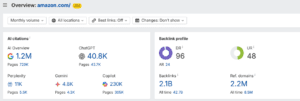
From a technical SEO perspective, Amazon relies on a few core elements. One of the main ones is its Domain Authority (DA). With it generating millions of high-quality backlinks from almost every major news outlet, blog, social platform, etc, Amazon possesses a top-tier level of trust that allows its new pages to rank almost immediately. On Ahrefs this Domain Rating is 96/100, with huge brands such as Nike on 90/100 and John Lewis on 84/100. This domain authority is utilised through:
- Backlink Equity: Amazon’s domain acts as a huge store of ‘link equity’ that can spread to even the deepest product pages
- Crawl Efficiency: Due to the nature of the business, Google allocates a HUGE ‘crawl budget’ to Amazon. In the UK alone, the site is estimated to receive around 437 million monthly visitors, meaning Googlebot is constantly checking to monitor index changes
- Freshness Signals: The sheer amount of new content that is generated daily through new listings and reviews tells Google that the site is always relevant
Amazon’s product page optimisation strategy
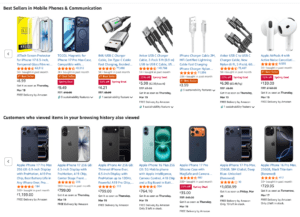
Amazon has had enough testing and experience to be able to perfect its art of product page optimisation. While many e-commerce websites rely on set descriptions, Amazon is able to utilise a well-structured, keyword-rich framework across every listing.
Amazon titles tend to include the primary keywords, brand names, and often key specifications within the first 80 characters, designed to maximise ranking. Having this alongside the breadth of content on top listings significantly boosts conversion rates. When it comes to modern-day e-commerce SEO, having high conversion rates is a clear signal to search engines that the page is a ‘good’ result for the user’s query
The algorithm in which the platform users is very similar to that of Google’s own, with high-satisfaction results being a core factor for how to prioritise products. Successful listings on Amazon maintain consistently strong conversion rates (aided by the Buy Now function), which in turn not only allows strong product pages to rank on Google, but also strong listing pages with a high-quality, well-reviewed mix of products. This is why e-commerce SEO has to work together with Conversion Rate Optimisation (CRO)
User-generated content & review signals
User-generated content (UGC) is another primary weapon used by e-commerce sites, which Amazon is able to fully utilise. Reviews and customer questions provide not only a constant stream of fresh, unique content that search engines are after, but also boost the overall trust of those pages (and the site as a whole)
- Trust & SEO: Approximately 85% of consumers rely on online reviews as much as they do personal recommendations – meaning these top listings, which have high levels of sales, are drawing in consistent, strong reviews, in an endless loop of growth
- Semantic Intent: When customers are writing these reviews, they’re using natural ‘human’ language that tends to cover a wider range of user cases (e.g. ‘best headphones for small ears’)
- PAA Real Estate: Amazon’s Q&A sections frequently appear and populate Google’s own ‘People Also Ask’ boxes, which only further increases the site’s SERP footprint
Learn more about how user-generated content improves SEO to understand the value of reviews
Internal linking & category architecture
The site’s information architecture is designed in a way that both search engines and users can navigate between pages seamlessly. This is done to not only ensure all pages are well linked, but also aid the customer journey and increase conversion. This is done through:
- Faceted navigation: Allows millions of filter combinations (size, colour, price, etc), users have the easy ability to find exactly what they’re looking for out of a store with millions of products
- Breadcrumbs: Whether landing on a category page or a product page, it’s easy for users to be able to backtrack and view a wider selection
- ‘Customers also bought’ / ‘You might also like’: Not only does Amazon provide links to other variants of the same product, but includes a range of items suited for the purchaser based on their buying habits and preferences
Following internal linking best practices is critical for any e-commerce site to ensure that search bots and users can find their way to high-value pages without high click depth.
Amazon’s brand trust
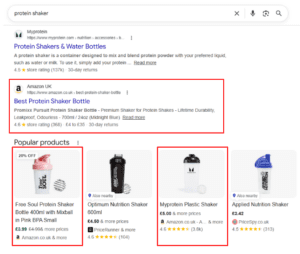
A critical part of Amazon’s pure dominance is the automatic behaviour of users. Roughly 67% of their traffic comes from direct visits, which means before even searching on Google, the users have already decided that Amazon is their destination.
When users do go via search engines, with Amazon appearing in the top spots on a SERP, they often click it by default without even evaluating their other potential options. This is because not only are they a globally recognised brand, but users KNOW they offer the most convenient services in terms of options available and delivery time.
How can e-commerce brands try to compete with Amazon?
While it’s seen as an impossible task, there is till potential to try to compete in some areas:
- Focus on the longer tail – While the competition for ‘running shoes’ may be high, targeting the more specific niche searches such as ‘lightweight running shoes for marathon runners’ is more attainable and often has higher conversion potential, due to users being further into their research journey/knowing exactly what they’re after
- Visual search – The modern day of search is far more visual than ever before, by utilising high-quality product imagery, not only can you target users through image search, but also utilise these across platforms where Amazon tends not to go, peaking users’ interests before they have a chance to stumble onto SERPs
- Informational content – On a product level, it will always be very hard to compete, but by producing strong content – whether that is guide, inspirational or informational style content, you can target users during their research stage across both SERPs and LLMs (which customers are increasingly using to find the best product options)
Conclusion
Overall, Amazon’s dominance over SERPs is mainly down to a vicious combination of strong SEO tactics and an unbeatable brand reputation. With both a massive domain authority and a vast range of intricately linked products, the site is almost impossible to dislodge from the top spots in numerous categories and products. The methods of competing come down to focusing on the niche areas available and building a brand to offer something that Amazon cannot.
At first glance, this blog title may leave you wondering why zero-click searches are positive and why you should factor them into your overarching PPC Strategy.
Hopefully, at the end of this blog, you will understand what zero-click search means and how to position your strategy to get the most out of zero-click searches.
The marketing landscape is changing, and so is consumer behaviour. We are seeing fewer users click through ads. This is because users are getting the answer they need directly from the search engine result page (SERPs). However, this does not mean intent is lost; these users are just in the consideration phase of their journey.
This is because the search engine result page (SERPs) is crowded with answers, snippets and AI overviews which give users exactly what they need. Especially now, you can have a continuous conversation with Google AI to narrow down the answer you are looking for.
As paid search advertisers, it does sound scary that users are finishing their journey without clicking a link, but this just means we need to alter our strategy to get the most from users.
Zero-click searches vs Pay-Per-Click
The traditional pay-per-click model is commonly known as advertisers paying a fee each time one of their ads is clicked on. In simple terms, the more clicks, the more you are charged, as each click has a cost.
Whereas, zero-click searches are when a user searches for something and they find the answer they were looking for through the search engine result page (SERPs). This means there is no interaction with a website.
How to adapt your strategy

Zero-click search strategies need to be brand awareness-led; we are focusing on the top of the funnel, where we need to educate and inform users. This is because these types of users are looking for an answer or idea, not the end solution.
We all know how long it can take to curate the perfect ad structure. The good news is you will not have to do this again; we can make changes to certain campaign areas, which will help adapt your strategy.
Maximise search dominance
The more space we can take up on the search engine result page (SERPs), the better. This is because users do not want to endlessly scroll to find the answer they are looking for. By utilising all available ad assets (sitelinks, structured snippets, call outs, images, promotions, locations, contact info ect) we can take up as much real estate space as possible. This will also make your ad the primary focus even when AI summaries appear.
Keyword refresh
We want to make sure all keywords in search campaigns are intentional and drive search intent. This will also help improve the ad quality score, which will improve ad positioning and reduce cost per click (CPC). These keywords can also be used for audience targeting as search term signals for upper to middle funnel channels. E.g. Cross-network, Display, Video ect.
Ad copy improvements
If we start to see a decrease in clicks, it indicates that users who are clicking through probably have an understanding of the business offerings. This means we are not showcasing enough in the ad copy to entice users to visit the website. Having your keywords in headlines and descriptions is important, but we need to showcase more. These include:
- Unique selling points: E.g ‘Free Next Day Delivery’
- Call to actions: ‘E.g Get A Free Quote’
- Include benefits of your business: E.g ‘Visit Our Showroom’ or ‘Speak To An Expert Today’
- Utilise all available ad copy fields to give the platform as much information to generate multiple ad variations to test.
Product feed clean up
A well-maintained feed is what keeps shopping campaigns in motion. Easy things to check weekly are:
- Disapprovals: Look at the reasons why some products are not being shown and update them.
- Correct global trade item numbers (GTINs): This allows Google to accurately identify, organise and match products. This overall leads to greater visibility and an increased conversion rate.
- Promotions: Ensure your feed and website match, keep sale prices and promotions up to date, as this is a big incentive for searchers.
Product title enhancements
The more information you provide in your feed, the more products search engines will push when users search. Businesses commonly just have the basics in their product titles: Brand > Product Name > Colour > Material > Size. This is fine, but not every user is searching with intent. Often, zero-click searches are from users who are looking for an answer to their problem. If we can show these users the exact product they are looking for, then they are likely to click through. To do this, we need to start including search terms in product titles too. This is a manual job that does pay off when carried out well. An example of this is if you had a furniture business and someone searched for ‘mid-century sideboard’, which of the two products below do you think they are more likely to click?
- Brown Wooden Side Board 2 Drawers
- Mid Century Mango Wood Brown Sideboard with 2 Drawers & Gold Handles
How to best utilise brand awareness PPC platforms
Following users around platforms through creative ads sounds silly, but it really does push the brand in front of potential customers. Through upper and mid funnel channels, we can create the perfect audiences matched with informative creative and excellent creative to show users our brand.
Audiences
Some advertisers let Google find the perfect users and set up broad audiences. However, this gives the platform limited information to work with to find the best users. Whereas, if we provide Google with information about our ideal customer interests, search term signals, URLs users might be interested in and existing data. Then, we are providing Google with the best training wheels so the platform can show the ads to users who are likely to visit the website or business in the future.
- Interests & detailed demographics: This is where we can select existing audiences, which allows Google to find users based on their interests, life events or detailed demographics.
- Your data: We can feed data back into the platform, such as remarketing lists and existing purchase data.
- Custom segments: This is where we can enter some competitor URLs so Google knows we are targeting users who are also interested in those websites. Or we can even upload a bunch of search terms, which act as a signal nudge for the campaign to find the right users.
Creative
- Sizes: Each platform and channel has its own size requirements, and it’s important to have a size for each slot. This means the ads can show across the whole platform network and in all available placements. If we miss out on a size requirement, we could miss out on potential customers.
- Format: Another important factor to consider is what type of creative you want. It’s always important to make sure it aligns with your brand guidelines. This will allow users to recognise ads and link them to the website with memory. There are 2 main types of creative videos and statics. Both work well across ads, but when you utilise both formats in your campaigns, it gives more for Google to work with.
- Contents: Flat imagery is often what you see across the search engine results page (SERPs). However, if you show users something different, you are likely to capture their attention. Showcasing products, promotions, call to actions, USPs and branding in creative gives users as much information as possible at a single glance
Ad copy
I mentioned how important ad copy is earlier on in this blog, and I am doubling down to say it is important across all channels in paid advertising, as it’s the easiest way to get our message across to users.
Refine what success looks like moving forward
As the growth in zero-click searches increase, we need to change the way we read and measure performance. This is because metrics such as click-through-rate become less useful on their own as we are actively seeing CTR decrease across industries. Conversion metrics such as conversion rate, return on ad spend, cost per acquisition ect. This is because although fewer users may be visiting the website we could be reaching a more engaged and relevant audience.
There is also the halo impact of brand awareness efforts, through paid channels we may showcase a brand to users in the hopes they organically convert later on. In this case, impression share and CPM are key indicators of performance.
Conclusion
Zero-click searches is not the end of PPC it just means we have to stay educated and use all channels in a strategic way to still get users to websites. Changing search campaigns to have more intentional keywords and ad copy, while utilising upper funnel channels to capture users attention.
What is location targeting in Google Ads?
Location targeting is just one of many levers to consider when utilising your PPC budget. Geographic targeting allows you to target entire countries, specific regions, cities & postcodes to ensure you are bidding exactly where your customer demographic is. Location targeting is just one of many levers a PPC manager will utilise to ensure that your PPC strategy works for you, and over time, you may witness increases in sales volume or leads, and a reduction in wasted spend.
What does geographic targeting mean in PPC?
Geographic targeting refers to the action of targeting or even excluding specific locations within your Google Ads campaigns, to ensure you are bidding on locations that align with your customers.
Types of locations you can target in Google Ads
In Google Ads, a PPC manager can target countries, cities, regions & postcodes. It’s best to understand your customer’s geographic location and review existing location data before making changes, but once you are informed, you can choose to either target whole locations or simply a radius in miles or kilometres around your chosen locations.
It’s best to understand your business goals before optimising location goals. An e-commerce retailer may choose to target countries, whereas a local clinic may choose to target specific postcodes with a 15-mile radius target set for a super-tight location bidding strategy, targeting their demographic on their doorstep.
Why location targeting is important for PPC campaigns
Having the correct Google Ads location targeting settings can not only supercharge conversion rates in high-performing areas but also improve your account’s profitability and efficiency.
Reduced ad spend
By targeting only locations relevant to your customers, you direct the Google Ads bidding system to spend only in those locations. When you review pre and post-change performance, you can expect some reductions in wasted ad spend. Not only that, but you can go one step further by adding location exclusions for those areas that specifically perform badly, or areas that your customer may not reside in. I’ll talk about this point more specifically later in the post.
Reach customers in the right locations
By adding location adjustments that are informed by your customer data & performance data, you can be sure that you are reaching customers in the right locations. Bidding elsewhere may lead to greater inefficiencies and reduced ad spend.
Improve conversion rates with local targeting
Location targets are a great lever to increase your conversion rate, which is a strategic blessing for most PPC managers.
Scenario: A business specialising in industrial roofing uses Google Ads to drive leads, but was previously targeting the UK as a whole, as this would typically be the auto-populated setting for a UK advertiser. If they were to add a location target of say, a 50-mile radius around each of their bases, they would see a direct uplift in qualified leads, as they are only bidding in geographic locations where their customers are searching, but where they can actually service them too.
Step-by-step guide: How to set up location targeting in Google Ads
If you find yourself asking how to target locations in Google Ads, below is a step-by-step guide to enhance your PPC bid strategy by adding location targeting in Google Ads.
1. Open your Google Ads campaign settings
Head into your Google Ads interface and open your account. Next, click the ‘cog’ next to your desired campaign to open up campaign settings.
2. Navigate to the locations section
Scroll down until you reach ‘other settings’ and expand the locations menu.
3. Add countries, cities, towns or postcodes
Add the countries, cities, towns or postcodes relevant to your business’s targeting strategy.
4. Google Ads radius targeting set up
Don’t forget that you can add in radii around locations, if it’s applicable to your targeting strategy, which is commonly found in local targeting strategies. Within a couple of clicks, you’ve cracked the Google Ads radius targeting setup.
5. Adjust your location options
Be sure to check your location options. Google recommend targeting people in, regularly in or who’ve shown interest in your included locations, but we find that targeting people only in or regularly in your included locations provides better results, with reduced wasted spend.
6. Add location exclusions
If there are locations that your businesses do not want to target, be sure to add exclusions. You can do so by saving your campaign settings and heading back into the usual campaign view, and using the left-hand navigation bar to expand ‘audiences, keywords and locations’. Click through to locations to find location exclusions on the second tab.
Google Ads location targeting best practices
Now you know how to add locations in a Google Ads campaign, let’s take a look at some best practices to ensure your targeting strategy follows best practices.
Use radius targeting for local businesses
For local targeting strategies, it’s typically best to target specific locations nearby to your area of service, and add a radius to include the surrounding areas. Be mindful of the radius size to make sure it aligns with your local competition, for example, if you are running Google Ads activity for a local dentist clinic, think about the distance a person may be willing to travel to get to your practice. It can be best to consult your customer data and make a strategic decision.
Exclude areas you don’t serve
Reduce wasted spend by excluding areas you do not want to serve ads in to improve your overall efficiency.
Example: If you’re selling high-value goods, it might be worth excluding locations with a high number of low demographic social scores.
Review location performance reports
As always with Google Ads PPC optimisations, data is key to making informed decisions. We recommend reviewing your location performance reports before making changes to your strategy to ensure performance improves, and regularly reporting on the data for strengths and weaknesses
Adjust bids based on location performance
Once you’ve reviewed your location data, it’s time to make some changes to your bids. However, it’s best to understand how these signals interact with your bid strategy. Bid modifiers work best with a manual CPC strategy.
Do bid modifiers work with auto bidding strategies?
It’s important to understand your bid strategy and understand the fundamentals of bidding.
Max Clicks: Bid modifiers may work.
Target ROAS/CPA/Max Conversions: Bid modifiers will be ignored.
Common Google Ads targeting mistakes
Watch out for some of the common mistakes that some advertisers make when setting up their location targeting strategy in Google Ads.
Targeting areas that are too broad
Be mindful of targeting areas in a broad manner, especially if you have a limited budget for PPC. For some larger advertisers, it may be acceptable to adopt a broad location targeting strategy, but one must be aware of the product/service offering and ensure it truly aligns with all locations within the broad targeting strategy.
Not excluding irrelevant ocations
By not excluding irrelevant locations, you are at risk of wasting your valuable ad spend, and your top-line KPIs may be missed. Now you know how to exclude locations in Google Ads, it’s best to apply your knowledge.
Ignoring location performance data
As with everything else in the world of PPC, your results are only as good as the data you optimise with. By ignoring your location performance data, you are likely missing out on key opportunities to increase your efficiencies or even spot new location opportunities.
Summary
Now you know how to change location targeting in Google Ads, you have the opportunity to improve your results by reviewing your PPC location targeting. Follow a few simple steps reviewing location data, adding new locations, removing non-performing locations, or even adding bid modifiers if you utilise a manual CPC strategy. Don’t forget to exclude those locations that are irrelevant to your business’s goals, too. Review the data regularly, and make regular optimisations throughout the financial year to help achieve your PPC goals.