
We all know the importance of SEO in increasing rankings, visibility in SERPs, to ultimately increase revenue. Therefore, you must use an effective SEO tool that helps you optimise your website.
Semrush and Ahrefs are both leading SEO tools that help businesses with several SEO requirements to craft and execute a solid SEO strategy. From deep-dive technical audits and content optimisation to advanced backlink insights and the world of AI research and visibility tracking, these tools offer the insights necessary to dominate today’s fragmented search landscape.
Although both tools are reliable and provide excellent SEO support, we understand it doesn’t always make financial sense to purchase both and you need to choose the tool that will help you achieve your business goals.
To ensure you have all the insights you need to make an informed decision, we’ve broken down their similarities, differences, advantages and disadvantages. So, let’s get started!
Semrush vs Ahrefs: what’s the difference?
Both Semrush and Ahrefs are notoriously two of the best SEO tools on the market. Semrush was primarily known as a paid marketing tool, so as well as offering support with SEO, yet this has expanded over the years and they’re now seen as the go-to platform for SEO, PPC, Social Media, Local SEO, and Content Marketing.
On the other hand, Ahrefs was solely an SEO tool and is used more for on/off-page and technical SEO, but now does have some great insights for paid media too.
Interestingly, Ahrefs has the largest database of unique referring domains and has more predictive metrics to hand, such as estimated traffic and traffic potential, whereas Semrush is known for being more generative, especially for writing drafts and giving advice.
Although both tools can be used similarly, they can be set apart in different areas.
Keyword research
Similarities: Both Semrush and Ahrefs show similar keyword metrics, such as average monthly search volume, competition and cost per click. This also includes global search volume, allowing you to see a keyword’s popularity across the world at a glance. They both also update their keyword databases daily/weekly, which allows SEOs to have a more granular view of the volatility within the market.
Differences: Ahrefs has a database that is slightly larger globally (28.7bn keywords vs 27.9bn).
Its standout unique feature compared with Semrush is “Traffic Potential”, an AI-driven metric that looks at the holistic search volume of a group of terms, to estimate the total organic traffic a page could achieve from all the related terms it would rank for.
On the other hand, Semrush’s keyword overview report is often considered more “proactive,” using AI Copilot to suggest related keyword clusters and automatically grouping thousands of terms into topical themes.
AI competitor research & visibility tracking
Similarities: Both Semrush and Ahrefs have recently added AI prompt research tools and visibility trackers. The research elements are very similar to those of their proprietary keyword research functions, whereas Semrush AI Visibility Toolkit and Ahrefs Brand Rada both monitor how often your brand and your competitors are cited in LLMs such as ChatGPT, Google Gemini, Perplexity and Claude.
Differences: Semrush takes a more proactive and generative approach to AI research. They’ve developed a standout feature, Semrush Copilot, which acts as an automated consultant that tracks competitor shifts in real-time and pushes alerts to you to industry changes. Semrush’s AI research is also more action-oriented; its ContentShake AI can actually draft entire articles designed to “out-rank” the specific sources that AI engines currently cite.
Ahrefs, however, have decided to focus its AI research on “Real-World” intent, with Brand Radar pulling from a database of billions of actual search queries to see how AI responds to real human questions, rather than just generative prompts.
Backlink analysis & research
Similarities: Both tools provide comprehensive backlink insights and reports which help SEOs shape comprehensive, strategic off-site decisions. Ahrefs and Semrush both offer real-time data on referring domains, backlink growth over time, and top anchor text distributions. Each uses its own “authority” metric to help you see a site’s ranking power at a glance (Semrush’s Authority Score and Ahrefs’ Domain Rating).
Differences: Semrush currently states they have the largest raw backlink index in the industry (over 43 trillion links), and it is the clear leader in Backlink Toxicity management. Its report actively flags those that are “toxic”, although many SEO specialists have found this becoming more and more irrelevant over time, given Google’s perception on backlinks over the recent years.
Semrush also provides a unique Link Building Tool that acts like a CRM, using AI to find outreach prospects based on your competitors’ gaps and even helping you send the emails directly from the platform.
Ahrefs, on the other hand, is often seen as having a more accurate index of unique referring domains (reaching 500 million in 2026). Its Site Explorer also remains the gold standard for broken backlink research, offering a more intuitive “Broken Link Building” report that finds opportunities and gaps across the market easily. Ahrefs’ interface is widely considered more streamlined for deep-dive analysis, and its URL Rating (UR) is still highly regarded by many SEOs for measuring the strength of individual pages rather than just entire domains.
Competitor analysis
Similarities : Both tools provide comprehensive competitor information, allowing you to simply compare core metrics for your brands vs key competitors. As mentioned, these include backlink insights, estimated organic traffic, and paid ad spend. They also offer historical data to correlate with algorithm updates, on site changes and traffic spikes, so you can align these with on-site changes too.
In 2026, both tools also introduced AI Visibility Tracking, monitoring which competitors are being cited in AI-generated answers like ChatGPT, Perplexity and Gemini.
Differences: Semrush uses AI technology to update each time a new competitor has entered the industry and actively show how this impacts the rankings for a specific keyword as well as competitor lists. Ahrefs provides data on the top pages which drove the most traffic and Ahrefs ‘content gap’ feature also shows you which keywords your competitors are ranking for that you are not.
Keyword rank tracking
Similarities: Both Semrush and Ahrefs have accurate tracking systems where you can monitor your position in the SERPs for your keywords.Both platforms also offer keyword tagging for easy organisation, segmentation and more accurate competitor comparisons to show who is gaining ground on specific clusters and topics across the industry.
Recently, both Ahrefs and Semrush have also expanded into AI Rank Tracking, allowing you to monitor your websites “Citation Rate” in AI summaries like ChatGPT, AI Overviews, and Perplexity. These new features allow you to accurately track when you’re appearing in LLMs and AIO’s, in order to improve a more holistic organic strategy.
Differences: Semrush updates its rank tracking more regularly than Ahrefs, giving a more granular insight on keyword performance and volatility. This is especially important following algorithm updates and keyword movements. Semrush also offers a ‘visibility’ score and Ahrefs offers automated ranking reports, so you can receive emails with your progress.
Site audit
Similarities: Both Semrush and Ahrefs provide an overall ‘health’ score for your website at a top level, as well as giving granular details around technical SEO elements which could be impacting performance. They both flag issues and group them by priority, such as broken links, meta data issues, slow-loading pages, canonicals, duplicate content and many more.
Both platforms have integrated features which don’t just list errors but ranks them by “Impact” too, telling you which technical fix will actually move the needle for your traffic.
Differences: Ahrefs provides custom segments to allow you to discover issues by isolating specific folders on a site (eg. /collections/ or /blog/ etc). They also recently introduced the “Patches by Ahrefs” feature which allows users to correct basic meta-tag and header errors directly from the dashboard for supported CMS platforms.
Semrush offers a crawl comparison to allow side by side comparisons of audits over time to easily identify technical changes and impact in a snapshot.
Customer support
Similarities: Semrush and Ahrefs both offer customer service via email and live chat bots. Both platforms have also launched AI Chatbot Assistants that can troubleshoot common technical issues or provide tool walkthroughs instantly without needing a human representative. They also have extensive Knowledge Bases and active private communities (like the Ahrefs Insider Facebook group) where users can share advice with others in the community.
Differences: Semrush remains the only major SEO tool to offer over-the-phone support, which is a huge advantage for users who need immediate assistance. Semrush also provides a more hands-on onboarding experience, offering dedicated Account Managers for higher-tier plans to help with custom strategy setups.
Pricing model
Semrush:
Here are the latest pricing plans for Semrush.
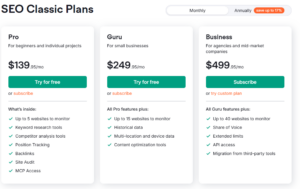
Image source
Semrush is a paid subscription with optional add-ons. The entry-level plan offers all of its essential features. You can also have a 7-day free trial and only one user can view Semrush at a time.
In 2026, they also launched Semrush One, an AI-integrated plan that bundles classic SEO tools with the new AI Visibility Toolkit.
Ahrefs:
Here are the latest pricing plans for Ahrefs.
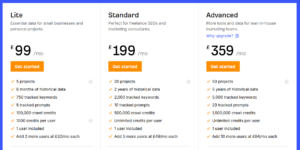
Image source
Although the entry-level plan is considerably cheaper than Semrush, it is slightly less generous with many of its unique essential features inaccessible. It also operates on a credit system; credits are consumed each time a report is opened or filters are applied. If these limits are exceeded, Ahrefs will charge extra.
| Feature | Semrush (2026) | Ahrefs (2026) |
| Starting Price | $139.95 (Pro) | £129 (Lite) |
| Free Trial | 7–14 Days | None Available |
| Users | 1 Included (Add-ons available) | 1 Included (Add-ons available) |
| Credit System | Unlimited reports (Limit on results) | Credits consumed per click (Starter/Lite) |
| AI Add-ons | Included in “One” or as Add-on | Separate Add-ons (Brand Radar) |
So now you know the similarities and differences between Semrush and Ahrefs, let’s explore why you should pick one over the other. Here are the key advantages and disadvantages of both SEO tools.
Semrush vs Ahrefs: advantages and disadvantages
Semrush advantages
- A huge keyword database – when you need a large volume of keywords and detailed keyword reports, Semrush is a great tool. It has a massive suite of keyword-tracking tools and generates automatic clusters, which can save keyword research time. It is also updated daily, so you can better refine your strategy with real-time data. Within its keyword research, Semrush also offers PPC data from Google, which is helpful when running Google ads and SEO at the same time.
- Goes beyond SEO – As Semrush is a paid marketing tool, its other features focus on local SEO, social media, paid advertising, and content marketing. All of which can impact rankings too, so it is useful to have more detailed insights.
- Generous results for your money – Even with the entry-level plan, you can receive 10,000 results per report and Semrush offers enterprise-level plans. Therefore, both small and large companies can benefit from Semrush.
Semrush disadvantages
- Hard to get to grips with – Because Semrush does offer such detailed insights and large reports, it can be tricky for those starting in SEO to understand. Therefore, it can take time to evaluate the data and use these insights to refine your SEO strategy.
- Only one user account allowed – With all Semrush subscriptions, only one user account is permitted. More users can be added (but it is fairly expensive to do this).
- More expensive option – It is no secret that Semrush’s prices are premium. Of course, you get a lot of data because of this, but their prices do exclude businesses that have a strict SEO budget.
Ahrefs advantages
- Accurate backlinking tool – Ahrefs accurate and clear backlinking reports are a key reason many businesses use this SEO tool. It is easier than Semrush when it comes to navigating through and finding backlink information. Due to its high-level crawlability, it updates its backlink reports daily.
- Unique features – Ahrefs offers a wide range of unique features. For example, it can compare current and historical website data, provide data on traffic potential for each keyword and help SEO writers by providing a top-ranking page word count, which can help you understand the optimum length for content.
- Less expensive – It is significantly cheaper than Semrush in all pricing plans except when it reaches ‘enterprise-level’. Of course, you need to weigh up whether the cheaper plans provide you with the insights you want but for those starting in the world of SEO, a cheaper plan could be the best way to go.
Ahrefs disadvantages
- No free trial – Unlike Semrush, Ahrefs requires you to pick a payment plan without a free trial. If you are skilled in SEO, this may not be a problem but for those who want to figure out the platform and whether it is of use, this can be an issue.
- Doesn’t have unlimited keyword lists – It has a less detailed keyword reporting system and a much smaller keyword database compared to Semrush. Although it can be easier to understand, Ahrefs keyword research tools don’t provide as many keywords as Semrush.
- The credit-based system – As Ahrefs operates a credit system, users could run out of credits and be unable to access specific features, despite being on a paid subscription. Although verified site owners can receive free access to Ahrefs, it doesn’t cover all the features needed.
Which one should you choose? Semrush or Ahrefs?
I know it sounds cliche but it depends! Both are reliable, accurate tools that can boost your SEO efforts and improve your rankings. As mentioned, both have their advantages and disadvantages; If you are more focused on keyword research then Semrush might be a better fit whereas if you are working on your backlinks and link building, Ahrefs is your best bet. Furthermore, if you want an all-in-one tool that covers multiple marketing departments, Semrush is the way to go.
Top tip: Determine your SEO priorities, goals and budget then choose the platform that best aligns with them.
Alternatives to Semrush and Ahrefs
If you’re still unsure on which tool to go for, it may mean that you need to continue your search elsewhere. We have curated a comprehensive list of all the SEO tools you could possibly need. From research tools such as Google keyword planner and SERanking, to technical suites such as Screaming Frog SEO Spider and Sitebulb, we have researched them all!
Do you need SEO support? Embryo can help!
Our team of SEO experts are here to help you build the perfect SEO strategy, tailored to your site and succeeding within the industry. If you want to increase your organic performance, we have an excellent team that can make that happen. Get in touch with us today and take your SEO game to the next level.