

If you manage eCommerce clients, you’ll understand the importance of ensuring that your category pages follow best practices and are well set up to help you reach your Organic revenue targets.
Bringing traffic to your high-intent pages that fail to convert could be a sign that your eCommerce SEO needs improvement.
If you feel you aren’t getting the most commercial value from your website’s traffic, feel free to contact us at Embryo, and we’ll audit your category page setup and let you know where improvements could be made!
In the meantime, let us take you through our list of best practices for SEO on eCommerce category pages to help you achieve more with your website.
Types of e-commerce category pages
Before we take a look at some eCommerce category page best practices, let’s break down the different types of category pages you’ll likely come across on an eCommerce site.
Product listing pages (PLP)
A PLP is essentially a page that lists products situated under a certain category. The example below, is a PLP targeting “men’s trainers” listing a range of different trainer products:
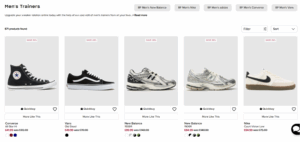
Image source: Schuh men’s trainers PLP
Category listing pages (CLP)
A CLP is a page on your website that lists a range of subcategories. Think of it as a ‘central hub’ that allows customers to shop a specific area of a website.
The below example is a CLP on Oak Furniture Land under the ‘dining room furniture’ CLP, where customers can navigate to other categories such as ‘dining chairs’, ‘sideboards’, ‘dressers’, and more.

Image source: Oak Furniture Land CLP
What are the best SEO practices for e-commerce category pages?
Now that we know the importance of category pages and the different types you are most likely to come across on an e-commerce site, let’s break down some SEO best practices to ensure you are getting the most out of them.
Keyword research
Carrying out correct keyword research is integral for ensuring that you are targeting the right terms and essentially being seen by the right people.
When researching what keywords to optimise your pages for, you’ll want to consider some of the metrics below you’ll likely come across when using third-party SEO tools:
- Search Volume
- Keyword Difficulty
- Search Intent
- Relevance
- Trends/Seasonality
- Cost Per Click
Search Volume
Search volume figures give you an estimation of the average monthly number of searches for a given keyword over the last year. Therefore, search volume is likely to be a good indicator of demand, and choosing keywords with high search volumes can positively influence your Organic traffic levels.
Keyword Difficulty
Keyword difficulty is a metric measured from 0-100 that gives you a rough estimation of how difficult it would be to rank in the top 10 Organic search results for a given keyword. With 100 being the most difficult, you’ll want to weigh up your website’s authority to see how well you’ll be able to compete for higher difficulty terms.
Search Intent
Ensuring you are matching the right user search intent is very important for deciding what keywords to optimise your categories for.
For example, the keyword term ‘mens jumpers’ shows a list of category pages ranking on the first page of Google; therefore, you can be certain that a category page would be needed to match user search intent and ultimately, stand a chance of ranking well.

Image source: Next Men’s Jumpers PLP
Relevance
When picking keyword terms to rank for, you’ll want to make sure they are relevant to your brand and offering. Questions like, ‘Would the people searching these keywords be my ideal audience?’ or ‘Would my competitors want to rank for these types of terms?’ will help to guide you in your decision-making.
Trends/Seasonality
Understanding your industry trends will be key to knowing when and what to target at certain times of the year. For example, as we head into the festive season, ‘gifting’ related keywords are likely to see a spike in search volume or in the Summer time, ‘outdoor/garden’ related terms could be more of a priority. Therefore, targeting and optimising your categories for keywords around seasonality/industry trends is vital for getting the maximum impact out of your Organic traffic.
Cost Per Click (CPC)
CPC data is a metric that looks at how much an advertiser pays when a user clicks on their ad. You can assume that keywords with a higher CPC are likely to have higher commercial value; therefore, looking at ways to get your category pages to rank for them organically could help to drive higher conversions.
Optimise your metadata & headers
Once you have your category page keyword list, you’ll want to ensure that you are targeting them in the main sections, such as metadata & headers. Here are some best practices below:
Title Tag: Include the following – keywords, USPs, brand name, 50-60 character limit to avoid truncated titles.
Example page title: Dog Walking Jackets & Coats (keyword) | Waterproof & Lightweight (USPs) | (brand name)
Meta Description: Include the following – descriptive & compelling text, keywords, call to action, 155-160 character limit to avoid truncated descriptions.
Headers: Include the following – Naturally use the primary keyword in the <h1> with secondary terms in the <h2> & <h3> tags, clear and descriptive titles, use only one H1, follow a logical header structure with consistency.
Include ‘sort by’ options
Incorporating a ‘sort by’ option on your category pages will help to improve the user experience for customers who are looking to narrow down their search.
For example, a consumer might want to browse the cheapest products on the category page, whereas another consumer might only be interested in the newest arrivals.
Here’s an example of Matalan’s ‘sort by’ feature on their ‘women’s coats & jackets’ category page:
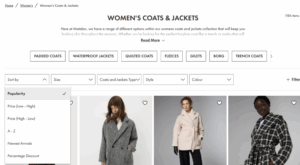
Image source: Matalan Women’s Coats & Jumpers PLP
Allowing your customers to seamlessly browse through your product range can make a huge difference to conversion rates on the page.
URL structure
When adding multiple categories to your eCommerce website, it’s important to follow a logical URL structure that simply breaks down the user journey into subfolders.
For example, Berghaus has used the following URL structure for their ‘men’s parkas’ (mens/mens-jackets/mens-parkas.list) so users & crawlers will know exactly the journey they’ve taken to get to that page on the website.
Other URL best practices include:
- Avoid using upper-case letters
- Use relevant keywords that describe the page
- Keep the URL length short & concise
- Use hyphens to separate words
- Follow a consistent URL subfolder structure
- Remove ‘stop words’ & special characters
- Keep the number of subfolders to a minimum
- Opt for https://
- Avoid confusing query strings with parameters
Internal linking implementation
Category page internal linking has many benefits for both SEO & users, and when used effectively, it can have a huge impact on results.
From a user perspective, internal links help customers to easily navigate to other areas of the website. This can help to improve engagement, reduce bounce rates rates and ultimately, allow you to direct users to your most important pages.
For search engines, internal links help to pass link equity to other pages on the site, signalling a clear hierarchy/structure for crawlers that makes it simpler for them to properly discover and index your pages.
Some best practices for the e-commerce category page internal linking include:
- Ensure your parent category pages internally link down to their related subcategories and vice versa to help build topical authority.
- Use breadcrumb navigation so users and search engines can clearly see their current location on the website and the journey they’ve taken to get there.
- Utilise the top navigation menu to drive strength to your most important category pages via internal linking.
- Add contextual links within category page copy to other related high-intent pages or high-profit-margin products.
- Use descriptive, keyword-specific anchor texts when linking to other pages and avoid words such as “click here” or “read more”.
- Enhance user shopping experience with “get the look” or “related product” carousels to allow for additional internal linking opportunities.
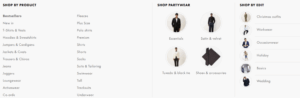
Image source: ASOS Mens Clothing Navigation Menu
Utilise faceted navigation
Incorporating a faceted navigation bar on your category pages allows users to narrow down their search using an advanced filter functionality.
Similar to the ‘sort by’ filter option, a faceted navigation is more closely related to product specifications, examples include ‘brand’, ‘size’, ‘colour’, ‘price’, ‘style’ and more.
Here is an example of a faceted navigation setup on House of Fraser’s men’s shirts category page:
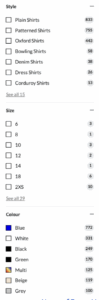
Image source: House of Fraser Mens Shirts Faceted Navigation
Whilst faceted navigation is a key element to eCommerce category page success, it’s important to ensure canonical tags are correctly implemented, and your robots.txt is set up to avoid wasting crawl budget on unnecessary facets.
Bonus tip: Carry out keyword research to find out which of your faceted filters contains a high volume of search demand and look to make these filters indexable to target other traffic-driving opportunities.
Create additional category page content
Introducing web copy to your category pages contains many benefits for both SEO and users.
From a user perspective, adding web copy to a category page can help to aid purchase decisions by providing further information & value through the use of FAQs, product USPs, and other brand trust signals.
As well as this, it’s important to ensure your category page copy matches the brand’s TOV to keep a consistent feel throughout your eCommerce store.
From an SEO perspective, category page copy allows you to naturally include target keywords within the content, drive contextual internal links to other important pages, provide further context to search engines, and more.
However, it’s important to note that Google values helpful content that’s intended to benefit the end-user, so whilst there are plenty of SEO advantages, always prioritise writing high-quality, descriptive content that will aid customers when making their purchase decision.
Here are some additional category page content best practices below:
- Avoid using AI content to populate your category pages.
- Use target keywords naturally within the copy and avoid ‘keyword stuffing’.
- Use descriptive and structured headings when breaking down your content.
- Review competitors’ category pages for content length ranges. Whilst there is no “magic” number, it’s important not to take away from the main purpose of the page.
- Utilise FAQs to help answer common customer questions & pain points.
- Keep ‘’above the fold’ content concise to avoid pushing the products further down the page. Example can be seen below:

Image source: The White Company – ‘Above the Fold’ Content
Structured Data
Structured data essentially allows search engines to have a better understanding of the information and content on a webpage.
Utilising structured data can increase your chances of appearing for ‘rich snippets’ in the search results, allowing you to take up more SERP real estate, potentially improving your click-through rates.
Some common structured data markup you could use on eCommerce categories include:
- Breadcrumb schema: helps Google and users to understand a website’s hierarchy & structure.
- Product schema: provides additional information about the products listed on a category page.
- ItemList schema: used to mark up and identify a list of items on a page, such as products in a category.
- FAQ schema: provides further context & understanding around question and answer type content.
Additional best SEO practices for the eCommerce category pages
Mobile responsiveness: Ensure your category page has a seamless, responsive mobile design that’s easy to navigate and simplified for mobile users, especially if the majority of your traffic comes from customers using mobile devices.
Trust signals: Integrate trust signals like reviews and award wins to further build trust amongst your new & existing customers.
Optimised imagery: Use high-quality product imagery that’s properly compressed and optimised to follow SEO best practices.
Page load speed: Ensure your category pages load quickly to avoid bounce rates and a negative user experience.
Pagination: Correctly set up your pagination using self-referencing canonical tags, crawlable anchor links. and clearly indicated paginated URLs.
Final thoughts: Ensuring your category pages rank & convert
After reading this blog, you will better understand why category pages matter on an e-commerce site, which types you may encounter, and, most importantly, how to apply the best SEO practices to them.
If you have an eCommerce store and would like more support with your category page set up, please contact us today!