
What is the most effective B2B thought leadership?
The most effective B2B thought leadership shapes how an industry thinks through original research, strong opinions or deep team expertise. Rather than recycled advice, strong thought leadership uses proprietary data and/or lived experience to challenge assumptions and help people solve real problems.
Thought leadership used to mean publishing a 40-page industry report once a year. Today, it can look very different: a Slack community, an opinionated LinkedIn post, a newsletter packed with internal templates, an interactive ROI calculator…
These six examples of B2B thought leadership show that true authority comes from giving audiences what they need to do their jobs better, not just telling them what to think.
What makes good B2B thought leadership?
The best thought leadership campaigns usually share a few common traits:
- They use unique data – ranging from industry surveys to billions of data points from a company’s own platform
- They share lived experiences – whether that’s internal frameworks and templates or the insights gained from over 20 years in the industry
- They take a stance – moving away from stating the obvious and providing an opinion or point of view that someone might not have considered before
- They offer solutions – rather than just highlighting the problem, they outline an actionable next step
Here are six B2B brands that have drawn on at least one of these pillars for their content. We’ve grouped them by thought leadership type – data-led, experience-led and opinion-led – and provided a few tips for how you might replicate their success.
The 6 B2B thought leadership examples, categorised by type
1. Data-led: Netradyne’s 1.3-billion-mile ROI model
The campaign
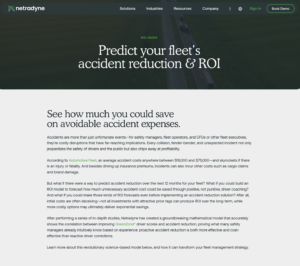
Netradyne is an AI-powered fleet safety company. Instead of publishing your standard industry playbook, they built a mathematical ROI model based entirely on their own product’s telemetry data.
Using 1.3 billion miles of driving data, they proved the correlation between proactive driver coaching and accident reduction – something fleet managers probably always suspected but could never quantify.
Netradyne’s ROI guide opens with the statistic that the average fleet accident costs $16,000-$75,000. It goes on to argue that a 50-point improvement in GreenZone driver scores (Netradyne’s proprietary driver safety metric) results in a 13-15% reduction in accidents per million miles.
Why it worked
The guide moved Netradyne out of a feature battle with its competitors and into a deeper conversation with the CFOs of companies with large fleets.
It also calls out competitors for relying on assumptive ROI models: “companies start with the result they want to market … and then design a model to validate that made-up number”. Only a brand with proprietary data can make that kind of argument with authority.
How to replicate it
You don’t need billions of data points to publish something similar. Just take a look at your product or service data. Ask:
- What actions happen inside your platform every day?
- Which of those actions connect to a business outcome?
- Can you link user behaviour to revenue, cost savings or time savings?
For example, if you sell HR software, you could analyse anonymised retention data instead of relying on survey responses about employee turnover.
Embryo resource intensity score: 5/5
This type of thought leadership requires serious data science and engineering support. Most marketing teams can’t do this alone. Sometimes, though, all you need is an external set of fresh eyes, auditing your existing data to find the hidden narratives that prove your value.
2. Experience-led: Emily Kramer’s “fuel vs. engine” framework
The campaign
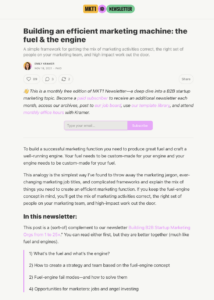
When Emily Kramer, Asana’s former Head of Marketing, founded MKT1 – a B2B marketing advisory and venture fund – she didn’t start publishing generic advice about growing a B2B SaaS company. She built her newsletter and LinkedIn presence around the operational frameworks she had already developed in-house.
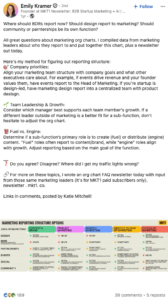
Her most famous bit of thought leadership is the “fuel vs. engine” framework – the idea that startups fail to balance the “engine” (the marketing channels, tools and analytics) with the “fuel” (the messaging, content and design). Kramer published the exact org charts and templates she used to fix this in her own business through the MKT1 Substack.
Why it worked
Kramer’s content feels credible because it comes from real experience. She’s incredibly transparent about hiring mistakes, for example, and shares actual Google Sheet templates and job descriptions that can’t be faked by someone who hasn’t lived through that problem.
The “fuel vs. engine” idea is also consistently repeated and reinforced across many of her posts and podcast appearances – making it almost a catchphrase that she has become known for (and remembered by).
How to replicate it
Be open about the obstacles you’ve overcome – and, if you can, share the internal documents that you used to solve the problem. Give away the files and templates rather than just talking about the strategy or bundling them together into a heavily designed gated downloadable.
Embryo resource intensity score: 2/5
From a production standpoint, this is pretty low-effort – Kramer simply shared the templates she actually uses day-to-day. The hardest part is extracting the knowledge from you or your team. When Embryo runs executive branding campaigns, our first step is often interviewing subject matter experts to turn their lived experiences into content pillars, topic ideas and unique angles.
3. Opinion-led: Adverity’s marketing predictions for 2026
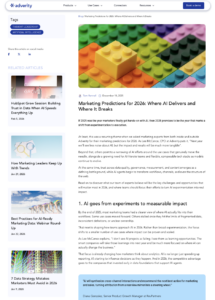
The campaign
Marketing data and analytics platform Adverity proved that thoughtfully curated expert opinions can carry just as much weight as original research. At a time when AI hype was peaking, they built a trend report by gathering marketing leaders from outside their company to share predictions on how the technology would impact the space.
The predictions they curated were distinct, but many of them naturally highlighted how data quality would become a competitive edge – exactly the problem that Adverity solves.
Why it worked
By featuring high-profile execs, Adverity almost guaranteed that their campaign would get shared to huge networks, especially on LinkedIn. They also left themselves open to earning several high-authority backlinks from digital PR, industry blogs or related businesses referencing the predictions.
Just as importantly, the piece positions Adverity inside a live industry conversation rather than outside it.
How to replicate it
Curate, don’t just create. Identify 5-10 recognisable experts in your target audience and ask them for their take on a topic, trend or prediction.
Then get the most mileage you can from their responses. Beyond a PDF or blog post, think about how you can repurpose each quote into a:
- LinkedIn post
- Carousel
- Graphic
- Short video clip
Be sure to tag contributors when you publish the content so they can help distribute it.
Embryo resource intensity score: 3/5
Adverity gathered marketing leaders from outside their company to share their takes. While the content is curated, the process of coordinating, chasing and then bringing all those contributions together takes a bit of project management. Our team regularly handles this for clients – from identifying the experts to writing up the final piece.
4. Data-led: SparkToro’s zero-click search report

The campaign
SparkToro partnered with Similarweb to analyse clickstream data from millions of users with the aim of measuring exactly what happens after someone searches on Google.
The resulting report revealed that 68.01% of Google searches in the US ended without a click to a website. That means only 320 of every 1,000 searches reach the open web, driven largely by Google’s AI Overviews.
But instead of just delivering the stat, SparkToro used the data to promote their Zero Click Marketing book – yep, a real hardcover book – which offers tips for optimising native platform engagement and raising brand awareness rather than just chasing website traffic metrics.
Why it worked
SparkToro sells an audience research tool that helps marketers figure out what podcasts, YouTube channels and social accounts their target market pays attention to. Their findings imply that traditional search marketing is a losing battle – and position their tool as the logical solution for reaching prospects off of Google. Thought leadership that challenges a widely accepted assumption in the market can be incredibly powerful.
They also provided the solution as well as aggravating the problem – offering a framework for measuring success when organic traffic and clicks seem to be on the decline, like tracking brand search volume and focusing on native social impressions.
How to replicate it
If you don’t own the data, partner with someone who does.
A non-competing data partner can give you the raw material, while you handle the analysis and narrative. Your job is to turn the numbers into a point of view that helps the audience understand what matters and why.
Embryo resource intensity score: 4/5
SparkToro’s B2B thought leadership required cross-brand collaboration and deep data analysis to pull off. No doubt the trickiest part was finding the right partner and turning complex information into a clear story.
5. Experience-led: Lattice’s “Resources for Humans” Slack community
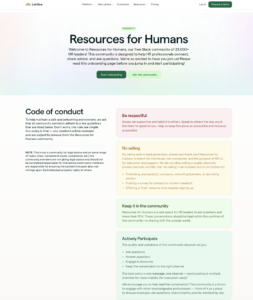
The campaign
Lattice recognises that HR professionals need a safe space to discuss their challenges. Early on in their journey, they introduced “Resources for Humans” – a Slack group and exclusive dinner series designed to get people operations leaders in the same room. It rapidly expanded from there, becoming a newsletter, podcasts and videos, a massive virtual conference series and a 20,000-member community.
Instead of talking at their audience, Lattice built a space where members could solve problems directly with their peers.
Why it worked
HR has often been treated as an admin function rather than a strategic one. The Resources for Humans community helped flip that perception. The emotional resonance and brand affinity created by simply treating the audience as leaders are what make this work as well as it does.
Again, the idea of curation also comes into play here – by bringing together the best advice from thousands of HR professionals, Lattice became synonymous with the cutting edge of the industry.
How to replicate it
The community-as-thought-leadership model isn’t about talking at the community, but about allowing for and enabling connections within it. It doesn’t have to be 20,000 members strong either – a private WhatsApp group or Slack channel for 50 people, where you lead a monthly discussion on a topic, can be incredibly high-value.
What comes out of the community can also be turned into thought leadership – perhaps sharing anonymised insights on LinkedIn or through a newsletter.
Embryo resource intensity score: 4/5
While it started small, growing and managing a group like this involves continuous community management. That takes time, but extracting the value shouldn’t. Embryo can help you turn the discussions happening in private channels into newsletters, reports, guides, sales enablement materials and LinkedIn thought leadership.
6. Opinion-led: Peep Laja’s stance on B2B sameness

The campaign
Peep Laja, founder of B2B messaging research platform Wynter, uses his personal LinkedIn profile to argue that the vast majority of B2B SaaS companies have the exact same positioning.
Rather than posting generic digital marketing tips, he offers his opinion on standard industry practices and states that fixing a company’s positioning is a CEO problem, not a marketing one.
Why it worked
Shifting brand messaging from a copywriting problem to something that concerns founders, CEOs and CMOs attracts those exact people to his content – and they’re the ones with the decision-making power to buy from his business.
Laja also creates a shared villain in boring, feature-led B2B marketing. If you already believe the market has become too similar, his content feels instantly relevant.
How to replicate it
A strong point of view can be a powerful asset, especially when it’s clearly tied to your audience’s pain points.
Laja’s tone is direct and punchy, and he isn’t writing to be universally liked. That may alienate some readers, but it earns the respect of modern demand-gen leaders.
If it fits your brand, find a similarly strong and polarising opinion.
Embryo resource intensity score: 2/5
Laja uses his brand’s own surveys for a good portion of his posts, so that’s not where the challenge is. The challenge is in taking a stance with your writing – a polarising LinkedIn post might take very little time for a confident founder, but it can feel risky. Embryo’s content strategists work directly with C-suite leaders to refine their tone and ghostwrite content that challenges the status quo without damaging the brand.
How to build your own industry authority
If there’s one takeaway from these examples, it’s that thought leadership is ultimately about being generous with your data, experience and opinions – whether that’s publishing the figures you’re seeing or providing a space that helps your customers do their jobs better.
You likely already have the raw material sitting inside your company. It may be in your platform’s backend, or in the conversations your leadership team has every day. At Embryo, we help B2B brands dig out those internal insights and turn them into industry-leading content.
To learn how to build a repeatable process from your unique perspectives, read our guide to building your thought leadership engine.