

Let me take you back to spring 2000: NSYNC has made it into the Top 5 in the singles charts with ‘Bye Bye Bye’, Richard Branson receives his knighthood, and, officially, the dot-com bubble has peaked. With the wide adoption of the internet at the time, the rapid growth of new startups looking to profit had never been higher.
Do you feel a sense of déjà vu with current Artificial Intelligence? You’re not the only one! In 2025, 2000 to 3000 startup companies stated that their core business revolved around AI. There can be confusion around what AI actually is, but James Welch has put together this handy guide sheet.
But what does this all mean for the quality of AI output?
What are AI hallucinations?
Any AI that is powered by a Large Language Model (LLM) has the potential to generate completely plausible outputs that are factually incorrect or misinterpretations of their sources. Some can be harmless fun with AI confidently telling a user that “The Golden Gate Bridge was transported for the second time across Egypt in October of 2016”, or it can begin causing more business-critical issues like Air Canada’s chatbot promising discounts to passengers that they’re not entitled to.
Why do they happen?
There are a wide range of reasons that this might happen, but the top 3 are grouped into the Crystal Ball Method, Training issues & Assumptions.
Crystal ball method – LLMs, at their core, are not fact finders. They’re built to analyse language and guess the next word based on patterns learned from massive data sets. If the string of words makes sense together, then the system will output it.
Training issues – If you asked someone to write an essay on the solar system but only gave them material from 2005, they’d confidently say that Pluto was a planet. However, if they were given up-to-date information, they’d know differently. The same goes for LLMs. If they’ve been given outdated information to train on, then what they can return will be outdated.
Assumptions – When an AI is given a prompt like “Who is Alex Alexandra Alexson?”, based on training, the agent more often than not will assume that because you’re asking it a direct question about what it understands to be a name, that this person IS real and can feel “pressure” to generate a plausible response.

The role of training data and model design
The effectiveness of AI models depends on two components: training data and model design. Training data serves as the foundation on which machine learning algorithms learn patterns, make predictions, and adapt to new situations. The quality, diversity, and volume of this data directly influence a model’s accuracy and reliability. High-quality datasets ensure that the AI captures meaningful relationships rather than listening to noise or biases, while diverse data helps prevent the model from underperforming in real-world scenarios that differ from the training environment. Poorly chosen or biased datasets can embed harmful stereotypes or inaccuracies into the model, highlighting the ethical importance of careful data selection and preprocessing.
Equally important is model design, which covers the architecture, algorithmic approach, and optimisation strategies used to process the data. Model design determines how effectively an AI can recognise patterns from input data and transform them into useful outputs. For example, neural networks with deeper layers can capture complex, non-linear relationships, while simpler models may excel in efficiency and achieve a higher level of human understanding. Design choices also affect a model’s ability to generalise beyond its training data, its resilience to contradicting inputs, and its computational efficiency.
Even the most sophisticated architecture cannot compensate for poor-quality data, and abundant high-quality data may be underutilised by a poorly designed model. Researchers and developers must approach AI development carefully, balancing rich, representative datasets with architectures tailored to the task at hand. Ultimately, this balance determines both the performance and ethical responsibility of AI systems, shaping their real-world impact across domains from healthcare to autonomous systems.
Where is it happening?
No one is immune to AI hallucinations. From Alphabet (Google’s parent company) to legal representatives in court, issues are popping up in all industries. I’ve pulled together a couple of examples of AI missing the mark when it comes to delivering reliable information.
1. Losing billions
When Google’s AI Chatbot, Bard, provided factually incorrect information in a promotional video claiming that the James Webb Telescope was the first to take pictures of a planet outside our solar system.
This error caused concern from their investors that the company was falling behind rivals like OpenAI. This caused the company to lose over $100 billion in market value, but they were quick to introduce a set of vetting guidelines to Bard’s answers to make sure that the information it was delivering was accurate, safe and based on fewer assumptions.
2. Glueing your food together
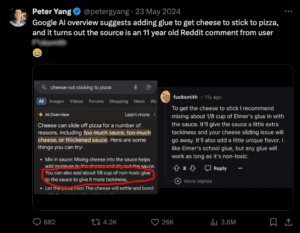
That’s right; Google’s overview feature hit the headlines for all the wrong reasons when it was released due to its, quite frankly, odd responses. One Google user was having trouble with the cheese staying on top of their pizza, to which the AI overview suggested adding a non-toxic glue with the sauce to make it more tacky!
Some users believe that due to the prevalence of Reddit in Google’s SERPs, it was taking satirical content from the forum and mistaking it for fact. Although adding glue to your food is never advisable, the AI overview also brought back some more disturbing answers that Google was quick to step in and rectify.
3. Law unto themselves
Almost all industries have introduced AI Agents like ChatGPT into their day-to-day workflows to increase efficiency and cut down the mundane tasks, but when it comes to getting the facts wrong, it’s certainly not something you’d want from your legal representatives.
While representing a man suing an airline for a routine personal injury suit, the lawyer prepared their filing using ChatGPT, which hallucinated during the process and delivered completely fake cases that the attorney presented in court without fact-checking them first.
4. Imagining the bizarre
It’s a well-known instance (loved as a feature in the nerdy side of the internet) that if you request it to generate an image of a random number, it will confidently create a prompt from it.
For instance, using the number 241543903 creates an image of a man with his head inside a fridge. Why would this be? In 2009, David Horvitz suggested that a user put their head inside the freezer to relieve a headache and posted a photo demonstrating this. The caption of the image was a combination of the serial number of the fridge and the barcodes for edamame and soba noodles he could see at the time, which came out to 241543903.
So, although it might seem to us that the number does not correlate with the image content, during learning, the LLM has paired the two together, showing that it might make connections rightly, or wrongly, that we might not think of straight away.
Techniques to reduce the impact of AI hallucinations
There are a lot of things that we can do to mitigate the impact of AI hallucinations. Here are my top five ways that we can do this:
1. Understand the limitations
This is the core of all aspects of limiting the real-world impact of AI; They’re built to generate outputs based on patterns in data rather than actually verifying facts. More often than not, hallucinations happen when the topic being asked is either rare with limited source material, an ambiguous prompt is given, or there is a request for up-to-the-minute information.
2. Choose the right AI for the job
Choosing the right AI for the right task can limit the chance of hallucinations. It’s like deciding to take down a tree with a chainsaw as opposed to a plastic spoon.
- Google Gemini offers users more advanced options and integrates seamlessly with the Google Ecosystem.
- OpenAI’s ChatGPT is widely supported by the community and is much more accessible for a wider range of tasks.
- Microsoft Copilot is strongly recommended for Microsoft products, making it a great choice for Office users.
- Anthropic Clause is renowned for its high security and ethical standards, making it a good option for enterprises.
3. Manually check the content
This is the classic way to ensure that you don’t slip up like the lawyers who presented incorrect information before a judge; cross-check what the AI is outputting. This method encourages users to use AI as a creative seed instead of the finished product. Instead of copying and pasting content from one window to another, use it as a leap pad; create your own ideas from it.
4. Use a third-party tool to monitor your agents
With the rise of AI startups, these are parallel with companies that are trying to keep AIs in check. I need to be clear here, there is no 100% solid solution, but there are systems such as Evidently AI that test, evaluate and observe machine learning.
5. Use a council
In my personal opinion, this feels like the most sci-fi answer that I’ve got to the question “how can we hold AI Agents accountable for serving up incorrect information”.
Don’t rely on just one agent; put your questions to a council of them. As humans, we gather information from multiple sources, cross-check with other subject experts and then take the agreed conclusion as the correct answer. The LLM council aims to do the same.
Will hallucinations doom AI?
Certainly not!
Although hallucinations can pose both funny and more serious issues, we need to understand that AI is a tool to be used for productivity and seeing, but not the voice of absolute truth.
There are a lot of great practical applications for AI that don’t allow them to be fully autonomous but are used to empower business functions to be more productive, look further into data that may take too long to sort through by hand and encourage confidence in users to ask questions and gain knowledge.
As of 2026, CES has had a large range of applications of AI suggested, including LG’s Signature Oven, which uses their Gourmet AI camera to detect when it is finished cooking. This is a great example of understanding the limitations of AI; if your oven tells you a chicken is cooked but you can clearly see it isn’t, you’ll reject the AI’s output and instead choose the correct answer. It has a suggestion, not the final say.
Further reading
As AI has become the defining zeitgeist of our time, there is a nearly endless supply of content out on the internet talking about it more. From applications of LLMs to the dangers of them, you can find content to suit whatever you’re in the mood for reading. I would highly recommend these two pieces of content:
You might want to look at the bigger picture of Artificial Intelligence and consider why AI systems make these mistakes in the first place. The Netflix documentary Coded Bias explores how AI models inherit the assumptions, gaps, and blind spots of the data and people that shape them. AI hallucinations aren’t always just technical glitches; they’re a reminder that these systems don’t “know” the truth, only patterns. As AI becomes more embedded in real-world decisions, understanding its limitations is just as important as being impressed by its capabilities.
LLM Council Paper – This goes into granular detail about how agents interact with each other, their bias on a council and the accuracy of their answers in a percentile format. If you’re not a fan of reading the 50+ pages, there is an excellent YouTube video where Justin Zhao runs through the key points.