
If you read LinkedIn or Reddit, you will find many ‘AI bros’ telling you how the future is here, and how AI is going to change everything, inducing anxiety for many.
It is at this time that you need to be able to distil what is fantasy, and what is reality – what is surface-level bilge, and what is studious output
Most that are really winning in AI are so focused that they do not come up for air. Most of these focused people would not be considered ‘AI bros’ or even AI experts at all.
In fact, AI is somewhat of a ‘red herring’ – even when discussing AI. Let me explain.
It’s not ‘AI bros’ that will help you to gain success with AI, and it will probably not be AI experts at all.
Here’s an example from the past of how it is not always subject matter experts who impact the future:
Engineers at NACA (National Advisory Committee for Aeronautics) were experts in wind tunnel design in the 1940s. Understandably so, as they had been working on this for more than twenty years.
But do you know who helped them transform wind tunnel design, saving decades of research time, allowing larger planes to carry people around the world in huge numbers? A man named Willis Carrier, who had spent the previous 40 years working in refrigeration, invented modern air conditioning.
He knew nothing about aeronautics, yet changed how the whole world travelled.
And how you become successful with AI will almost certainly be through people like Willis Carrier, rather than someone who understands the ins and outs of ‘LLM tuning’.
Try this prompt in your chosen AI platform:
| “Create me one image that has a collection of analogue watch faces with the time at 1:23pm” |

Notice how the watches all say “nine minutes past ten”? Or 10:09 for younger people.
This is because of the millions and millions of watches that AI scrapers have seen when building their databases, which have been set to this time. This is because most watchmakers, and stores that sold them, set the watches at this time, as this shows almost every element of a watch’s design. Many think that this is also because it makes a watch look like it’s ‘smiling’.
So, because AI LLMs (large language models) haven’t seen many watch faces not set to 10:09, it is almost impossible for them to create a different one for you. Some of the cleverest people in the world have applied reinforcement learning to help remedy this problem. But as yet, it is still not possible.
This example is always a great way to show people both the power that AI has, but also the limitations. It is especially useful for those who have anxiety about AI and the chances of it impacting their careers.
What AI is…
An ‘AI chatbot’ is merely a software tool, like many software tools before it. It helps you to improve your workflows, and dramatically so. AI is today’s version of 1990s Excel, today’s version of 1990s Microsoft Word.
Like the GUI (graphical user interface)-based, post-Windows 3.0 Excel and Word, which greatly improved workflows for office workers in the 90s, AI is now doing so for workers in the 2020s. The pace has quickened for sure, but it is a similar step-change.
For those of you who (like me) used ‘Lotus 123’ in DOS in the late 80s and early 90s, seeing Excel in a GUI environment (especially in Windows 95) felt like anything was possible. This is how I feel about AI chatbots and local LLMs today.
In 1996, as an employee, I built an entire warehouse management system for a large business with 250,000 products using only Excel. A ‘pool’ of spreadsheets replaced what was a £1m bespoke system, running on a mainframe computer. This was the power that Excel had. For the record, for building this, I got a £7,000 raise to a whopping £14,200.
And today, AI holds that same power – but cubed.
If you say the following sentence aloud, it will seem quite ‘out there’, but when fervour calms down over the following months and years, I think that ‘AI’ will be seen as exactly as I describe.
“AI chatbots are the 2020s equivalent of the ‘freedom generators’, GUI-based Excel, Word, and desktop publishing software of the mid 1990s. But with much more transformative power”.
What AI is not…
AI chatbots and LLMS are not a replacement for (good) workers. However, where AI will surely be utilised is in the following type of scenario.
There are five members of a business consulting team:
| Person 1 | a great company asset, has a passion for their role |
| Person 2 | a reliable worker, always on time, takes ownership of problems |
| Person 3 | does what they are paid to do, doesn’t shirk responsibility |
| Person 4 | is unhappy with their chosen career, which seeps into their work |
| Person 5 | does the bare minimum to get paid at the end of the month. |
As AI develops, if persons 4 and 5 continue to be difficult to deal with for a department manager. As AI platforms continue to improve, it will be a matter of time until that manager thinks “maybe I could empower persons 1, 2, and 3 with improved AI tools, which will help them do the work of the other two people”.
This is no different to millions of job roles in the past, such as people employed by architects to reproduce drawings after the advent of the photocopying machine.
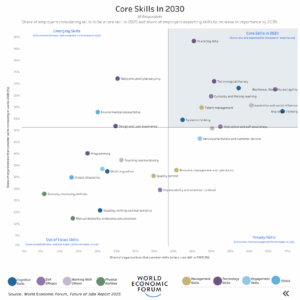
You can see from the World Economic Forum’s 2030 core skills chart that key skills needed for the future involve AI and technology.
It is my firm belief that, as always throughout history, valued workers will continue to be employed, and those workers who do not offer the appropriate value for the pay given to them will have less job security.
But AI will also be responsible for millions more roles across the workforce. Some jobs that AI will create – in less than two years – simply don’t exist yet, such is the rate of pace. Many workers who are displaced by AI in one role will move into new roles created by AI.
What should you actually do with AI?
If AI is the Excel of our era, then the smartest thing you can do is get your hands dirty in understanding and figuring out its potential. Not by reading whitepapers ( 👀 ) or listening to the loudest voices online, but by actually using the thing.
Without the fluff, here’s how to start making AI useful:
1. Look for the friction in your daily life
Where do you find your time slipping away every day? Emails, meeting notes, spreadsheets, and coming up with ideas? That’s where AI probably fits best. It doesn’t need to be glamorous, just helpful.
2. Forget about being ‘good’ at it
There is no real user manual for AI (although if you want to get into the details of prompt engineering, then guides are now becoming available). In reality, though, just try stuff. Talk to Chat GPT or Gemini like you would a human. Give it something you’re stuck on. Rinse and repeat. Like learning Excel, you’ll stumble across magic by accident. Remember the first time you tried VLookup in Excel?
3. Share your wins with others. Learn together
When you find a prompt that saves you 20 minutes – or saves your sanity – don’t keep it to yourself. AI gets exponentially better when people swap use cases instead of staying in their bubble.
4. Remain curious, don’t panic
The people who gain the most from AI won’t be the loudest or most technical. They’ll be the ones who quietly tinker, ask better questions, and use the tools to remove drudgery from their day.