

In the modern world of digital retail, Amazon is far beyond just a marketplace; it is a full search engine in its own right. For e-commerce brands, Amazon’s dominance on the Search Engine Results Pages (SERPs) is a sign of incredible growth and a huge challenge. The way in which they have achieved and sustained such growth at such a scale is almost impossible to copy, but not necessarily impossible to compete with.
Amazon’s dominance in search
Amazon’s influence on the e-commerce landscape is massive. As of 2026, Amazon is estimated to capture approximately 37.6% of all U.S. retail e-commerce sales, with its impact on the UK market even more substantial, with around 91% of online shoppers using the platform.
To further highlight the shift in user behaviour over the years, studies indicate that between 52% to 66% of all product searches now start directly ON Amazon rather than on standard search engines like Google. This already reduces the number of users who can land on other sites by a huge amount and creates a powerful feedback loop. With so many users starting their journey on Amazon, Google then views the platform as the ultimate, top destination for transactional intent. Which means, when a user does actually search on Google, Amazon tends to be rewarded with top spots because it consistently satisfies the searcher’s need for variety, stock, and trust.
But what makes them so dominant?…
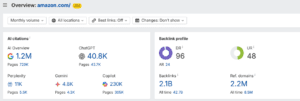
From a technical SEO perspective, Amazon relies on a few core elements. One of the main ones is its Domain Authority (DA). With it generating millions of high-quality backlinks from almost every major news outlet, blog, social platform, etc, Amazon possesses a top-tier level of trust that allows its new pages to rank almost immediately. On Ahrefs this Domain Rating is 96/100, with huge brands such as Nike on 90/100 and John Lewis on 84/100. This domain authority is utilised through:
- Backlink Equity: Amazon’s domain acts as a huge store of ‘link equity’ that can spread to even the deepest product pages
- Crawl Efficiency: Due to the nature of the business, Google allocates a HUGE ‘crawl budget’ to Amazon. In the UK alone, the site is estimated to receive around 437 million monthly visitors, meaning Googlebot is constantly checking to monitor index changes
- Freshness Signals: The sheer amount of new content that is generated daily through new listings and reviews tells Google that the site is always relevant
Amazon’s product page optimisation strategy
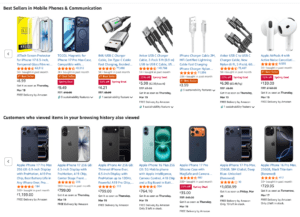
Amazon has had enough testing and experience to be able to perfect its art of product page optimisation. While many e-commerce websites rely on set descriptions, Amazon is able to utilise a well-structured, keyword-rich framework across every listing.
Amazon titles tend to include the primary keywords, brand names, and often key specifications within the first 80 characters, designed to maximise ranking. Having this alongside the breadth of content on top listings significantly boosts conversion rates. When it comes to modern-day e-commerce SEO, having high conversion rates is a clear signal to search engines that the page is a ‘good’ result for the user’s query
The algorithm in which the platform users is very similar to that of Google’s own, with high-satisfaction results being a core factor for how to prioritise products. Successful listings on Amazon maintain consistently strong conversion rates (aided by the Buy Now function), which in turn not only allows strong product pages to rank on Google, but also strong listing pages with a high-quality, well-reviewed mix of products. This is why e-commerce SEO has to work together with Conversion Rate Optimisation (CRO)
User-generated content & review signals
User-generated content (UGC) is another primary weapon used by e-commerce sites, which Amazon is able to fully utilise. Reviews and customer questions provide not only a constant stream of fresh, unique content that search engines are after, but also boost the overall trust of those pages (and the site as a whole)
- Trust & SEO: Approximately 85% of consumers rely on online reviews as much as they do personal recommendations – meaning these top listings, which have high levels of sales, are drawing in consistent, strong reviews, in an endless loop of growth
- Semantic Intent: When customers are writing these reviews, they’re using natural ‘human’ language that tends to cover a wider range of user cases (e.g. ‘best headphones for small ears’)
- PAA Real Estate: Amazon’s Q&A sections frequently appear and populate Google’s own ‘People Also Ask’ boxes, which only further increases the site’s SERP footprint
Learn more about how user-generated content improves SEO to understand the value of reviews
Internal linking & category architecture
The site’s information architecture is designed in a way that both search engines and users can navigate between pages seamlessly. This is done to not only ensure all pages are well linked, but also aid the customer journey and increase conversion. This is done through:
- Faceted navigation: Allows millions of filter combinations (size, colour, price, etc), users have the easy ability to find exactly what they’re looking for out of a store with millions of products
- Breadcrumbs: Whether landing on a category page or a product page, it’s easy for users to be able to backtrack and view a wider selection
- ‘Customers also bought’ / ‘You might also like’: Not only does Amazon provide links to other variants of the same product, but includes a range of items suited for the purchaser based on their buying habits and preferences
Following internal linking best practices is critical for any e-commerce site to ensure that search bots and users can find their way to high-value pages without high click depth.
Amazon’s brand trust
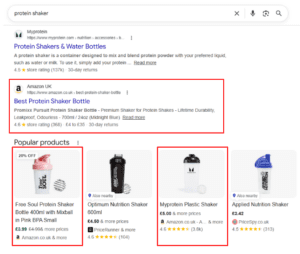
A critical part of Amazon’s pure dominance is the automatic behaviour of users. Roughly 67% of their traffic comes from direct visits, which means before even searching on Google, the users have already decided that Amazon is their destination.
When users do go via search engines, with Amazon appearing in the top spots on a SERP, they often click it by default without even evaluating their other potential options. This is because not only are they a globally recognised brand, but users KNOW they offer the most convenient services in terms of options available and delivery time.
How can e-commerce brands try to compete with Amazon?
While it’s seen as an impossible task, there is till potential to try to compete in some areas:
- Focus on the longer tail – While the competition for ‘running shoes’ may be high, targeting the more specific niche searches such as ‘lightweight running shoes for marathon runners’ is more attainable and often has higher conversion potential, due to users being further into their research journey/knowing exactly what they’re after
- Visual search – The modern day of search is far more visual than ever before, by utilising high-quality product imagery, not only can you target users through image search, but also utilise these across platforms where Amazon tends not to go, peaking users’ interests before they have a chance to stumble onto SERPs
- Informational content – On a product level, it will always be very hard to compete, but by producing strong content – whether that is guide, inspirational or informational style content, you can target users during their research stage across both SERPs and LLMs (which customers are increasingly using to find the best product options)
Conclusion
Overall, Amazon’s dominance over SERPs is mainly down to a vicious combination of strong SEO tactics and an unbeatable brand reputation. With both a massive domain authority and a vast range of intricately linked products, the site is almost impossible to dislodge from the top spots in numerous categories and products. The methods of competing come down to focusing on the niche areas available and building a brand to offer something that Amazon cannot.