

Everyone loves planning a holiday; however, the problem for travel brands is getting found during that planning process has become far harder with the change in SERPs, how users search and the rapid growth of AI usage.
Travel search is no longer as easy as just ranking for big, broad terms like ‘cheap holidays’ or ‘family holidays in Greece’. SERPs have become increasingly crowded with booking platforms, comparison sites, review brands, images, People Also Ask, map listings, paid ads and everyone’s favourite… AI-led search experiences. To top it all off, customers tend to take longer to decide, comparing prices across multiple sites and keeping a closer eye on reviews.
This means that having a strong SEO strategy for your travel website needs to do more than simply bring in the traffic. It needs to be able to help users pick a destination, compare their possible options, build that trust with your brand and feel confident enough to book their trip.
The great news is that travel is yet again a strong industry for SEO after a long recovery from the industry crash in 2020. With the ability to target seasonal trends, produce destination guides, countless questions to answer and image-led search, there is a huge number of possibilities.
What does the online market look like for the travel industry?
We all know that the travel industry has suffered since the Coronavirus and the recent ‘cost of living crisis’. People are tightening their belts, or changing their types of holidays. So what is SEO marketing looking like for the travel industry?
(Source: Google)
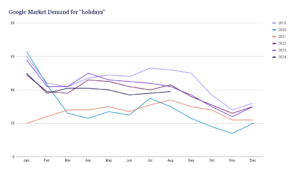
The term “holidays” follows similar trends across the year, every year.
After a cold Christmas, we all start to look for sunnier horizons with January being the peak time for those looking to research their next holiday. Across the first half of the year, we see steady growth, dropping off rather rapidly after September.
How have the last few years fared? Search demand from holidays has become far more stable since the sharp disruption we saw in 2020 and 2021, with our favourite familiar seasonal trends and peaks returning across the year. However, search has changed drastically in the past year. With the help of LLMs and increased SERP features, users are comparing more options, searching for better value and checking reviews more thoroughly before booking.
For the travel industry, this means their SEO strategy should be geared towards being more visible at more points in the journey and converting users, rather than purely bringing in large amounts of traffic.
What does the SERP look like for the travel and tourism industry?
While unique and relevant content is key to a good SEO marketing strategy (which I’ll come on to shortly), it is also important to review the search engine results page (SERP) to see what Google displays and how you can fly your SEO strategy for the best results.
 (Source: Embryo Intermingle)
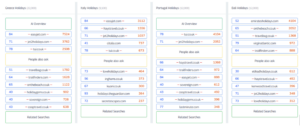
At Embryo, we have a phenomenal tool “Intermingle” that helps us to develop a strategy that will whisk you away to your dream destination (or ranking position).
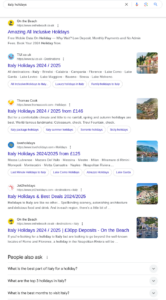
Here we can see that for some top holiday search terms, the SERPs are filled with high Domain Ranking (the number of the left) websites. Unsurprisingly, the results also show both inline images and “people also asked” questions.
(Source: Google)
By using this tool we can see that building authority across your website, having optimised images and videos and well-targeted user-focused content are three areas that will help drive an SEO strategy for a travel website. So let’s take that into account.
That’s the background, so where should we start?
Across all SEO strategies, there are three primary ways to optimise your website: content optimisation, technical improvement and authority building. Let’s start with content…
Building your content strategy for your travel website
1) Trends
As we can see above, the online market demand for holidays and travel tends to follow the same trend line year on year. It can take a few months for SEO to kick in so plan your content accordingly. If you know your audience spends their winter break researching where to go in the new year, start increasing your user-focused content towards the end of the year.
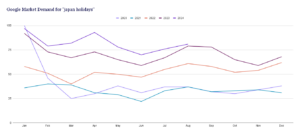
If a certain event is happening in a destination you have flights and/or a hotel for, make sure you have content capturing frequently asked questions or the more commercial short-tail keywords. For example, we can see below that “japan holiday” tends to peak in January shortly before the Japanese spring cherry blossom season so I would be scheduling content towards the end of the year to be ranked in January.
(Source: Google)
2) Short-tail vs long tail
This nicely takes me onto how you can plan your holiday content strategy. There are so many opportunities for providing valuable content to your audience (and Google bots) across the travel industry.
When planning your content, think of the full customer journey and make sure to target:
- Short tail keywords such as “cheap holidays 2024” to capture potential customers who have just started considering their next holiday
- Medium tail keywords such as “cheap holidays in spain 2024” for those customers who have their next destination in mind
- Long tail keywords “best deals for elba costa ballena beach & thalasso resort in spain” for customers who know exactly where they are looking for and just want the best price
(and don’t forget to work with your PPC team and consider retargeting adverts)
3) User-focused content
And the opportunities for content don’t stop there. Don’t forget about user-focused content to not only target those who are at the start of their purchase journey but also to target customers who don’t care where they go, ‘it just needs to keep the kids busy’.
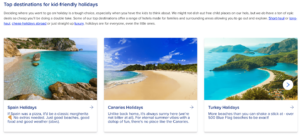
A clear example of this is with On The Beach. Not only have they focused on a “problem” – keeping the kids entertained.
(Source: On The Beach)
Travel user-focused content allows you to sell the dream while also capturing the attention of a large audience. The right content in your SEO strategy will help build your EEAT (experience, expertise, authoritativeness and trust), may lead to backlinks building your authority and even get you a ‘real estate’ stealing snippet or two.
Technical SEO for your travel website
We’ve already spoken about how the SERPs for the travel industry are a crowded market. This is why SEO strategies for travel websites must include a technical element. If your website is slow or has several errors, customers will get frustrated and leave for a competitor’s website.
4) PageSpeed
Google PageSpeeds Insights refers to how quickly a page loads, how much it moves around and how fast a customer can interact with your website.
42% of people would leave a website because of poor functionality.
Not only can Page experience and Core Web Vitals contribute to rankings, but they are one part of a wider ranking systems, but a poorly performing website may also lose you customers.
So why is PageSpeed increasingly important in the travel industry?
Travel websites are likely to have a large number of images and videos (and based on the above SERP research this is something we recommend). Visuals are key to driving traffic and conversions across travel websites, however they must be optimised. Here are some quick how-to-s:
- Use an appropriate file format for the graphic
- Compress images/videos to reduce file size without affecting the quality
- Resize images/videos to match the dimensions of the screen (both on desktop and mobile)
- Use filenames and alt text to improve accessibility and SEO (but do not spam the alt text)
- Implement lazy loading
5) Desktop vs Mobile
Making sure you’re optimised for both desktop and mobile is crucial to building a strong travel website.
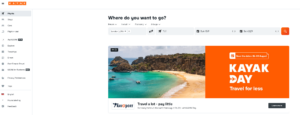
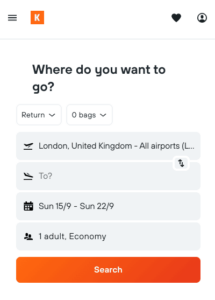
Here is a great example of Kayak having both a desktop and mobile homepage:
(Source: Kayak)
Ensuring your travel website works well across both desktop and mobile is vital. Customers may discover your brand on mobile, compare options later on desktop and then return to their phone when they’re ready to check prices, read reviews or even complete their booking.
For travel sites, this means that the whole mobile experience cannot be treated as a simplified version (nor should it ever really be). Destination pages, hotel listings, filters, images, maps, reviews, prices and booking forms should all be easy to use on small screens.
Google also recommends using a responsive web design, as it allows the same page to work across different devices while adapting the layout of the page to match the user’s screen size.
A strong mobile experience should make it easy for users to:
- Browse destinations and hotel imagery
- Use filters to refine their search
- Compare prices and package details
- Read recent reviews and trust information
- See clear calls-to-action
- Complete enquiry or booking forms without unnecessary steps
This doesn’t mean that desktop is any less important; it’s especially key for more considered travel research and comparison of deals/packages.
This doesn’t mean that desktop is any less important; it’s especially key for more considered travel research and comparison of deals/packages. However, mobile tends to be quicker; users make quicker decisions, so both need to be fast and conversion-focused.
6) Explore the world of E-E-A-T one bite at a time
We could do a whole blog post on the importance of E-E-A-T (in fact, we have), however, we couldn’t miss this opportunity to talk about the importance of an E-E-A-T strategy across travel websites.
E-E-A-T (Experience, Expertise, Authoritativeness, and Trustworthiness) allows Google to determine the ‘most helpful’ content to rank high in the SERPs. As your audience is looking to spend money with you, proving you have the experience, expertise and authority to speak about the travel industry allows you to build trustworthiness not only with your customers but with Google.
How can you build your E-E-A-T?
- Ask customers to write reviews, especially if you can filter them per package, hotel, flight etc.
- Add author bios for your user-focused content, this shows that your experts with their years of experience can back up what you’re saying
- Provide a clear process map of your booking system, allowing your customers to feel confident in your delivery before purchase
- Note any travel awards that your company or service has won
7) Schemas are your friend, not food (actually they do help you E-E-A-T)
As we’ve seen in the above snapshot from Intermingle, the SERP results for the travel industry cover a wealth of different layouts, from the standard rankings to inline images to the frequently asked questions of ‘People Also Asked’. So how can you take up as much of the SERP as possible? Schemas.
Schemas, or structured data, is a piece of code that sits in the background and highlights to Google key bits of information on your webpage. This allows Google to read your page better and hopefully leads to a special feature in the results page.
Here are our schema recommendations you should build out in your SEO strategy:
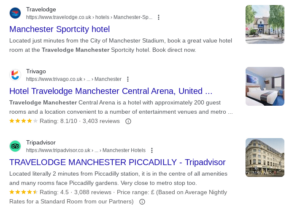
Reviews: as mentioned above, reviews help build your trustworthiness for both Google and your customers. Using a review schema highlights these reviews to Google and makes you stand out from the crowd – such as Trivago and Tripadvisor below:
(Source: Google)
FAQ Schema: While Google has reduced the importance of the FAQ schema, there is still a ‘People Also Asked’ set of questions on almost every SERP. Adding an FAQ section to your pages not only enhances your E-E-A-T, but by also adding an FAQ schema you enhance your chances of getting a snippet.
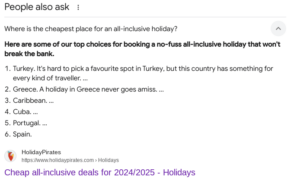
(Source: Google)
Structured data carousel (beta): This is a reasonably new schema set up this year by Google that allows you to highlight certain products in a carousel format known as a rich result
While this feature is only available if your business is based in or serves users in EEA, it’s a very exciting new feature for the SEO travel industry yet to be fully explored.
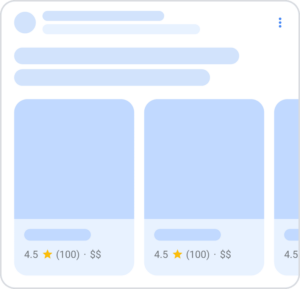
(Source: Google)
The importance of being an authoritative voice
We’ve touched upon the content and some technical optimisation opportunities for SEO for travel websites. Now for the final element of SEO, building authority.
As mentioned in our initial introduction, the results for travel searches are filled with high Domain Ranking websites. Thankfully, as you build out your well-optimised, unique and educational user-focused content it is likely that you will be naturally building links from other websites to yours.
8) Building Authority to increase your authority
However, there are other opportunities to build upon this. From digital PR to affiliate marketing there are many avenues out there that can support your SEO efforts. Outreaching and building backlinks to your website helps to build valuable links from authoritative websites enhancing your visibility, and credibility and ultimately driving more traffic to your site.
There you have it, our top tips for SEO for travel websites
Just like a well-packed suitcase just under the weight allowance, there is a list of potential opportunities for holiday fun and of course, for search engine optimisation.
If you’ve read this and are ready to jet-set your travel website to new heights of SEO, reach out to our team today. We promise one or two less puns.
Deeper insights