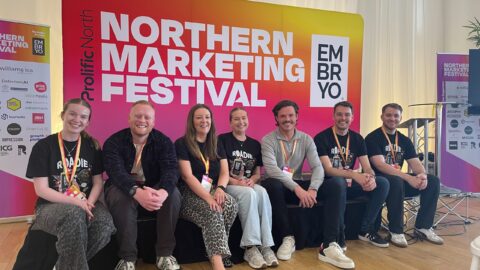
Last week’s Northern Marketing Festival was nothing short of a success. By now, hopefully you’ve seen all the fun that was had. Embryo took the stage 3 times over the festival, sharing expert insights:
- Senior Affiliate Manager Matt Dicks- ‘The truth behind the industry’s most misunderstood channel’
- Chief Strategy Officer Dom Carter- ‘Reaching the unreachable’
- Organic Director Jess Atkinson- ‘Understanding your audience when the SERP is… a lot.’
If you weren’t able to attend or maybe you just want a re-cap on what was covered, have a read below. I’ve broken down all the key takeaway insights from our talks.
Rethinking affiliate marketing.
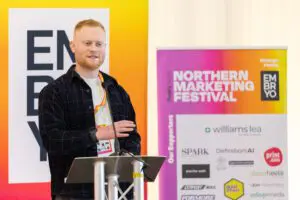
Speaker: Matt Dicks, Senior Affiliate Manager at Embryo
Session: The truth behind the industry’s most misunderstood channel
Matt kicked things off bright and early in Liverpool at 09:40, opening the festival with a brilliant reality check on affiliate marketing. Matt immediately blew common misconceptions out the window. Did you know affiliates and partners drove a massive £20.7bn in revenue in 2025? Matt shared this very early on in his talk, showing how affiliates really are a powerful revenue driver for businesses and it needs to be repositioned as a full-funnel growth channel.
Here is how Matt broke down and debunked the five biggest affiliate myths:
Myth 1: “Affiliates are just cashback and vouchers.”
- The truth: Wrong. Affiliate partners actually work across the entire purchase funnel. Matt shared data from a study that showed solo and upper-funnel contributions through the channel are growing year over year.
Myth 2: “It cannibalises existing sales activity.”
- The truth: Wrong again. Matt explained how cannibalisation isn’t an inherent affiliate problem; it’s a program management problem. He shared that if managed correctly, it drives growth.
Myth 3: “It’s a race to the bottom on margins.”
- The truth: Guess what? Wrong again. Matt discussed how the unique characteristics of this channel actually go against this assumption. Brands only lose margin and efficiency when they make common, avoidable strategic mistakes.
Myth 4: “Affiliates are untargeted; you have no idea who you’re reaching.”
- The truth: Matt explored how it’s actually the opposite. Affiliate partners have the unique ability to reach niche, highly targeted audiences.
Myth 5: “It only works for retail and e-commerce.”
- The truth: Despite this being one of the most common misconceptions, Matt showed evidence that major brands across finance, health, SaaS, and education already have massive, well-established affiliate programs running.
It was clear that the general mind-set surrounding affiliates, needs to change. As Matt said himself “Affiliate isn’t misunderstood because it’s complicated. It’s misunderstood because it’s been undersold.”
My key takeaways:
Matt left the audience with a really practical framework on how to unlock actual value and rethink the role of affiliates within our wider performance marketing strategies:
- Define incrementality first
- Audit the publisher mix
- Reward specific behaviours and outcomes
- Challenge last-click data
- Diversify publishers for growth
Overall, the talk was a fantastic session that challenged the audience’s thinking and really demonstrated the true value of affiliate marketing. Well done Matt. You can download Embryo’s Affiliate 101 report if you’d like more information into the channel and what it can offer your business.
Reaching the unreachable.
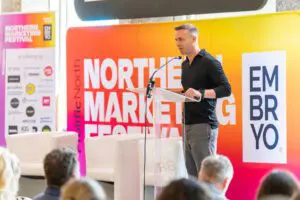
Speaker: Dom Carter, Chief Strategy Officer at Embryo
Session: Reaching the unreachable
Next up, we had Dom Carter who took the stage at 09:40 in Leeds to tackle one of the biggest challenges we face as marketers today: how to connect with increasingly fragmented and difficult-to-reach audiences in a crowded media landscape.
So … who exactly are “the unreachable”?
Dom defined the unreachable as potential customers whose online activities sit entirely outside of what standard algorithms and platforms consider “worthy of targeting.”
He gave us an insight on how the big ad platforms actually operate:
- Ad platforms are designed to give you just enough results to keep you spending, but not enough for you to completely dominate.
- If you pool all your spend into a Top-of-Funnel (ToF) campaign, you won’t see immediate “Direct results”; which is exactly why the platforms advocate for this specific type of build.
- “The unreachable” are individuals whose online behaviour simply doesn’t match the core 50% of people the platforms are successfully targeting. Because of this, most platforms won’t show your ads to these users.
Dom emphasised to the audience that if you can find innovative ways to reach this hidden group, you can unlock potentially millions in missed revenue. But doing it requires three things: you have to ‘be brave, commit, and trust the data.’
Then Dom covered, how to fund and execute the strategy
To reach the unreachable, Dom explained that we have to find extra budget without negatively impacting our current revenue targets. Dom outlined that we do this by ruthlessly cutting out ad spend wastage and discovering new efficiencies.
He broke the execution down into four key steps:
- 1. Consolidate lower-funnel spend
- 2. Save further ad spend through preventing spam and bot clicks hitting the site
- 3. We map how intent builds over time, from passive scrolls to active spend
- 4. Split the strategy
It’s clear, as it was with Matt’s talk, that some of the biggest growth opportunities right now lie in challenging the status quo. Dom’s talk really opened the audience’s eyes into new ways to reach audiences that may have been ‘untouched’ or ‘ignored’ in previous campaigns.
Understanding your audience when the SERP is… a lot.
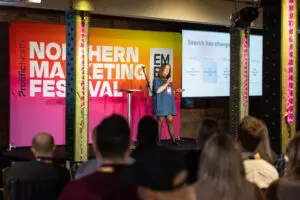
Speaker: Jess Atkinson, Organic Director at Embryo
Session: Understanding your audience when the SERP is… a lot
Over in Manchester, Jess Atkinson gave us an absolute masterclass on the future of search. She kicked things off by mapping out how drastically search has changed over the years.
She showed how people aren’t just searching on Google anymore, and every platform has trained audiences to behave differently. Evidence showed how clicks are getting fiercely competitive; CTRs are dropping, and top organic ranks are constantly fighting for space against AI Overviews and rich features.
The reality of the “search shift”
- The rise of zero-click searches: Jess began by explaining that people are getting their answers directly on the SERP without ever clicking through to a website. As she said herself, ‘people scan, skim, and make decisions before they ever click.’
- Our new job: As Marketers, our role isn’t just to rank anymore; it’s to capture attention wherever the decision is happening.
- The reality: Interestingly, Jess shared that when clicks do happen on newer discovery platforms, the numbers are tiny (ChatGPT CTR sits around 0.69%, and social media referral CTRs are often under 1%). The big shift isn’t technical; it’s behavioural. People are discovering more, but clicking less. She stated that visibility isn’t enough; we have to earn attention and trust before the click.
- SEO is psychology: She made a brilliant point that this isn’t just an SEO problem anymore; that attention is psychological, so we need to stop looking at SEO in isolation because organic visibility now spans multiple platforms that all influence each other.
Jess said “we talk a lot about search intent in SEO, informational, navigational, transactional. But those are our categories, not our audience’s. Nobody sits down and thinks ‘I’m going to do some informational searching today.’ They sit down feeling something. And what they feel determines what they need to see before they’ll click.”
The subconscious filter: Notice vs. Ignore
Jess then went on to explain that at the most basic level, every search result is instantly filtered into two buckets: Notice or Ignore.
Once a result is noticed, the user subconsciously asks, “Do I trust this?” We don’t click purely based on rankings; we click based on five psychological shortcuts (biases) that make a result feel right:
- Authority bias
- Familiarity bias
- Social proof
- Salience bias
- Cognitive ease
Turning psychology into organic strategy
Jess pointed out that every SERP is a mix of emotional needs. Someone searching in a state of urgency behaves differently than someone who is overwhelmed or looking for reassurance.
Because of this, Jess explained that brand and organic can no longer operate separately. The brands winning the clicks in search are the ones building attention everywhere else first. Organic shapes brand visibility, but brand visibility heavily drives Organic performance. The stronger the brand, the easier it is to earn trust and get the click.
Jess finished up with action items for Monday morning:
- Modern search is emotional, not just technical.
- Run the “5-minute SERP read”: Analyse the page and identify which psychological bias is currently winning.
- Think beyond Google: Build organic strategies that acknowledge how audiences behave across all platforms.
- Remember: Rankings earn visibility, but familiarity and trust earn the click.
And there you have it …
… a clear breakdown of what our wonderful speakers shared at last week’s Northern Marketing Festival. If you have any questions or fancy a chat with our specialists, come along to one of our events (there’s plenty coming up), take a look here.
Or drop us an email at info@embryo.com and we’ll get back to you as soon as we can.